





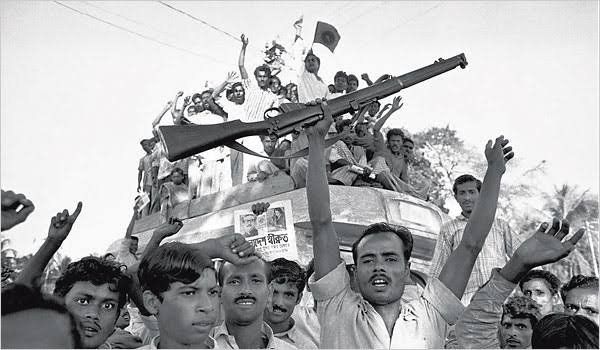
Pause for a moment before reading this as history. Instead, try reading it as a morning you did not wake up in, but ended up inheriting. Imagine opening your eyes on December 16, 1971 without knowing what the radio was going to broadcast, what the newspapers would print, what borders would harden by nightfall. Imagine the quiet before meaning arrived. Because this date did not come bearing a one truth. It arrived differently, solely depending on where the sun found you standing that morning.
In what would soon be known as Bangladesh, the morning carried a strange mix of disbelief and relief. The war ended, but nothing really felt finished. Independence didn’t suddenly burst in the streets as one entity, but rather, independence evolved gradually from pain, loss, and exhaustion. Independence for the people of Bangladesh wasn’t a moment to celebrate their survival more so than a moment to celebrate their independence. There were missing family members, damaged cities, and a greater burden of what had been lost versus the possibility of what lay ahead. But even though the weight of loss was heavy, there was an irreversibility at work; there was a claim on the future made after years of denial and being left unheard.
In Pakistan, the same date felt like a rupture rather than a beginning. It was a morning that unsettled the idea of nationhood itself. A nation that once envisioned itself spreading out over two wings woke up to find that one was severed. What occurred in the geographical sense on December 16, 1971, is a far cry from the psychological and mental loss of what could have been. The end result of the loss was over thirty years of confusion, defensive behavior, and complete silence. Today, with the exception of a few writers who are willing to be honest about the events of December 16, 1971, the event has remained largely censored, sanitized or diverted from the need for open and honest discussion. This event produced many disturbing questions regarding commonality of experience and commonality of responsibility; but those questions have gone unanswered for so long.
India experienced yet another version of the same sunrise. Except for India, the morning symbolized victory and strategic success. It marked the culmination of political calculation and military intervention, a moment that reshaped the region’s balance of power. Yet even here, the meaning was not uncomplicated. Triumph unfolded alongside refugee crises, humanitarian suffering, and the awareness that war, even when framed as necessary, leaves consequences that do not end with surrender ceremonies. This morning carried confidence, but also complexity—a reminder that intervention is never a clean act.
What makes December 16,1971 endure is not merely what happened, but how differently it is remembered across all 3 countries. One date, three narratives, each one incomplete without the others. History is not one voice up on the podium, it’s more like memories that overlap, contradict, and go silent. When one version is exalted over others the past becomes distorted.
This date can, of course, be reduced to slogans: independence, defeat, victory. However, slogans are a poor way to describe a very human experience. They dismiss the fear of civilians, the uncertainty of soldiers, the grief of families who did not know which side of history they were expected to be on. The people who lived through December 16, 1971 did not experience it as a page in a history book. They lived through a day which was the turning point of their lives.
You might wonder why this date still asks so much of us. Why it continues to unsettle conversations more than half a century later. The answer is simple: history that is not fully acknowledged does not fade. It embeds itself quietly in institutions, in national attitudes, in the way countries respond to dissent and difference. The past demands recognition.
Remembering December 16,1971 does not require choosing sides. It requires holding multiple truths at once. It means honouring Bangladesh’s independence as a hard-won and deeply painful birth. It means allowing Pakistan the space to reflect honestly rather than defensively. It means recognising India’s role without stripping it of moral complexity. All these truths don’t threaten each other; in fact, in my opinion, they depend on each other to make sense.
If you are still reading, then this date already lives inside you as well. It lives in what you were taught and what you were not. In the pauses that followed certain questions. In the discomfort around certain conversations. December 16, 1971, exists not just in archives and speeches, but in inherited memory, memory that is spoken about softly, or, well, not at all.
The sun rose only once on December 16, 1971, but it created three different mornings. One of independence, one of loss, and one of victory. History did not choose a single meaning, and perhaps that is the quiet lesson here. Our responsibility is not to decide which morning mattered most, but to remember that all of them did.