





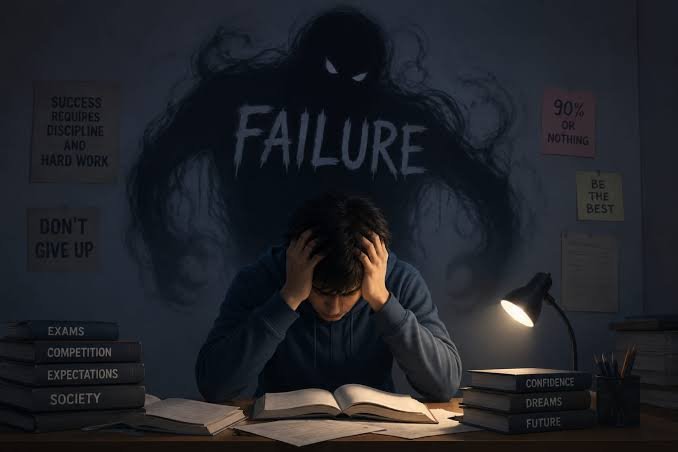
What does it feel like when your whole life is treated as a rat race? When every achievement is marked and paraded, while every setback is sighed upon as if it were a blotch on the fabric of honour? When your every step is meticulously monitored and recorded on a scoreboard just to be periodically compared to that of your cousin’s or your father’s uncle’s friend’s dog’s owner. When every single event in our life elicits such excessive reactions and scrutiny, it is no wonder that Pakistani kids these days have come to fear failure so intensely.
It is only natural for humans to slip and fall, to tumble and fumble; how else are we supposed to know what sticks and what doesn’t? It is this series of trial and error which helps us learn of what we are in this world full of possibilities and opportunities. To find our place in this world, we must open all kinds of doors and see which one leads to home. One must trudge through mud and sand before they find their footing. And the more one trudges, the more footholds one shall find.
While this concept of reckless youth and finding oneself appears very romantic in theory, it is only so fearful in application. Failure is terrifying, yes, but it is only an essential part of growth and development. This notion, however, is lost on our Pakistani society. In this highly competitive society, the youth have no room for failure. It is outdo or be outdone. It is not far-fetched to assume the comparative nature of our elders. Being compared to our cousins in academic achievements is practically a rite of passage for any brown kid at this point and when you see your cousins getting medical and engineering degrees, you can only try and ignore the seething glares from your relatives that demand excellence equal to, if not exceeding, that.
Our marriage market further encourages this phenomenon. In a country that predominantly has arranged marriages, the standing of a person in their career is of paramount importance. Every family wishes to wed themselves to an academic household, one where everyone holds a substantial academic or occupational value. Where people can’t find love, they look towards convenience. Bachelors with significant earnings are coveted, and bachelorettes with educational achievements are prized. It is then, unsurprising, that the emphasis on one’s education is so substantial.
Humans are measured not on their character, their religious affinity, their kindness or their senses of humour, but on a more objective criterion which involves academic milestones and career breakthroughs. And, of course, these triumphs are to be attained at as young an age as possible. Alas, people then turn their eyes towards little Fatima, who likes maths and maps out her future as an extraordinary engineer, or perhaps they see 10-year-old Arslan playing with a children’s doctor set and exclaim how he must be passionate about the profession. And it becomes his misfortune to pursue it.
This highly competitive environment has undoubtedly set our youth on edge. Everyone is terrified of the prospect of taking the wrong step, of failing and disappointing their families. It has become a matter of shame to not know what you want because one must have their entire life figured out at the age of 20. The kids are being crushed under the unrealistic expectations of society. It is disgraceful to fail a test. It is absolutely, agonisingly humiliating to struggle to find a job. It is unreasonable to pursue the arts, reprehensible to take a non-linear path in life and outrageous to tread unconventional routes. For it is risky, and the chances of failure are abhorrent, and God forbid we fail, for that would bring dishonour to the family, and the shame would always hang from the ceiling.
We cannot entirely blame our elders; sure, their ways are old-fashioned and often toxic, but they aren’t entirely wrong. Not long ago, we were under the rule of the British Empire, where we were discriminated against in jobs and markets. Even after the partition, Pakistan had negligible resources, and refugees spilt out of cities. A lot, if not most, of our forefathers have led a life of poverty and hardship. They have seen the struggles that come with unemployment, and they have had to strangle the throats of their desires with their own trembling hands.
Keeping all that in mind, it is only understandable that they wish for better lives for their grandchildren. They insist on us keeping our noses buried in books so we don’t smell the hunger and the poverty that is on our heels. They tell us to walk the path of life and walk fast so we can outrun our misfortunes. They urge us to opt for conventional careers because those are the only ones they know that will put money in our pockets and food in our bellies.
Their reasons are straightforward to understand but difficult to agree with. The love of our parents has started to feel like the shackles of fate. Their excessive concern, births worry and anxiousness. It is important to have at least a vague idea of what you want your life to look like, but it is just as important to realise what you do not wish to be a part of that life. And the only way of knowing that is making mistakes. Fucking around and finding out.
Life loses its glamour if it is not shrouded in mystery. The forest loses its mystique at the presence of a paved path, so one must scavenge deep through the trees and forge their own. It is of no consequence if you trip on an overgrown root from time to time; at least you’ll know that that hurts and you should carry a pack of bandaids. And maybe you’ll discover the colour of your own blood.