





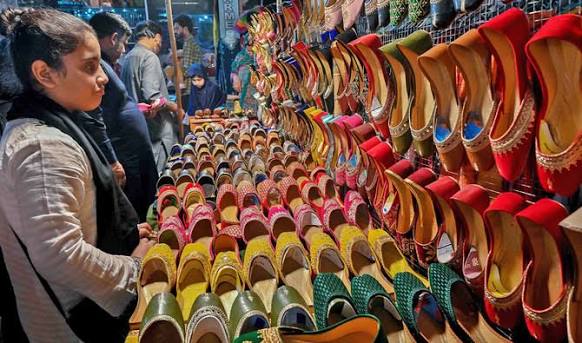
The city doesn’t truly wake until it pretends to sleep.
When the last office light blinks off and the evening call to prayer fades into humid air, Lahore sheds its daytime skin. The night markets emerge as a second city layered over the first—a parallel universe of sizzling griddles, string lights twisted through trees, and the particular electricity that only happens when strangers gather in the dark to eat, to buy, to simply exist.
Stand at Liberty Market on a Friday night and watch the transformation. Heat still rises from pavement, now mingling with smoke from seekh kebab grills and the sweetness of jalebis spiralling into hot oil. Young couples drift past, maintaining that careful distance that means everything and nothing. Families sprawl on plastic chairs, children sticky with kulfi, parents bent over plates of chaat. Vendors call out in half-song, half-invitation. But they’re not just selling food. They’re selling the night itself.
This is the genius of night markets: they offer what the formal economy cannot. A place to exist without the weight of productivity, a commons where time moves differently. In Lahore, where summers make daylight unbearable and social conservatism complicates public space, the night market becomes radically democratic. Here, a college student on two hundred rupees shares the same pavement as a banker, the same fluorescent glow, the same permission to linger. The darkness itself is equalising.
Most vendors operate in what economists politely call the ‘informal sector’—which really means they exist in the cracks of official recognition. The uncle selling grilled corn from a modified cart, the teenager hawking phone accessories from a folding table, the woman ladling lentils from steel pots balanced on bricks and fire. None appear in GDP calculations. None pay corporate taxes. None exist in the databases governments use to understand their cities. Yet collectively, they form an economy that feeds families, creates jobs, and answers a need that gleaming malls cannot: the need for affordable joy.
There’s a particular mathematics to survival here. A corn vendor might earn two thousand rupees on a good Friday night, maybe three thousand during wedding season. Subtract the cost of corn, coal, butter, the two hundred rupees to the municipal worker who looks the other way, and the hundred rupees to the boy who minds the cart during prayer time. What remains is thin, uncertain, unglamorous. But multiply this across thousands of vendors, across dozens of neighbourhoods, and you glimpse an economic force that sustains more people than any quarterly report ever could.
Watch the street food vendor work, and you’re watching performance art. The precise crack of the puri, the choreographed pour of spiced water, the timing perfected over decades until it becomes muscle memory. This isn’t just eating. It’s participation in something older than any of us, a ritual that connects this Friday night to countless Friday nights before, stretching back through generations.
But beneath the carnival atmosphere runs a current of negotiation. Night markets exist in a state of semi-permission, tolerated more than welcomed, and are subject to sudden crackdowns when an official decides the chaos has gone too far. Vendors arrive knowing they might be dispersed by police, pack up their entire enterprises in minutes, and reconvene a week later at a slightly different location. It’s urban hide-and-seek that exhausts everyone involved but somehow persists because the need—economic, social, existential—is too great to ignore.
Safety here is communal and improvised. In conservative societies where women’s access to public space is constantly policed, night markets create complicated shelter. The darkness that might threaten on empty streets becomes protective when surrounded by crowds and light. Families serve as unwitting chaperones; their presence makes the space safer for everyone. Young women travel in groups, a mobile fortress of friendship that allows them to claim hours that might otherwise be forbidden. The mathematics of safety are collective: enough people means enough witnesses means enough accountability means just enough freedom.
And there’s something profoundly human about people who choose to gather after dark, who resist the pull of home, screens, and private comfort. In an era of increasing atomization, night markets insist on a different possibility. They remind us that we’re a social species, that there’s pleasure in proximity, in the vulnerability of eating in front of strangers, in the democracy of standing in the same queue regardless of what you drove there in.
The belonging forged here is temporary but real. Regulars develop relationships with vendors—the man who knows you like your tea extra sweet, the woman who saves you the best samosas. It’s the kind of casual intimacy that cities usually destroy. For newcomers, for migrants, for anyone trying to find their place in the overwhelming machinery of urban life, night markets offer a soft landing: a space to observe, to participate slowly, to belong without the burden of explanation.
These markets are also stages for the young. In cities where formal entertainment is expensive or culturally complicated, they become sites of courtship and friendship, spaces for the performance of selfhood that youth require. The careful choreography of who sits where, who walks past whom, the studied casualness of it all—this is social education conducted away from family oversight, the negotiation of identity and desire that every generation must conduct somehow, somewhere.
As Lahore modernises, as malls proliferate and apps promise delivery of everything, the night markets not only persist but multiply. They persist because they offer what optimisation cannot: the beautiful inefficiency of human gathering, the unscripted possibility of what might happen when people share space, darkness, and food. They persist because they employ people the formal economy has no room for, because they feed people who cannot afford restaurant prices, because they create public life in a society increasingly hostile to it.
Stand in a night market long enough, and you’ll see the entire city pass through: rich and poor, families and loners, believers and sceptics. Everyone is hungry; everyone is looking for something beyond mere sustenance. In the glow of neon lights and cooking fires, in the smell of grease and spice, in the noise of bargaining and living, you glimpse the city as it actually is: improvised, resilient, more generous than it knows, never quite containable by anyone’s plan for it.
The griddles keep sizzling. The lights keep glowing. The city keeps insisting that there are other ways to be. And in the morning, when vendors pack up and pavement returns to its daytime self, the night market disappears like it was never there—until Friday comes again, and the neon flickers back to life, and strangers become a city once more.