





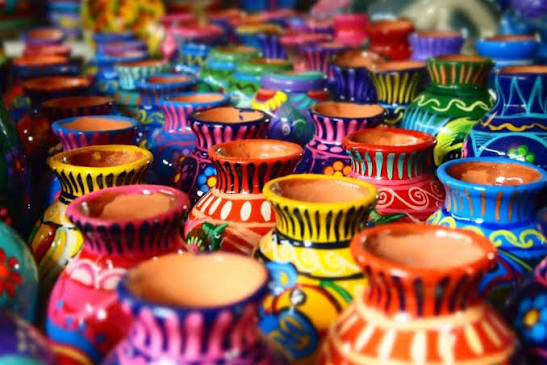
From Phulkari and Ajrak to truck art and blue pottery, Pakistani artisans have long created crafts that are now vital parts of our culture and identity. For as long as any of us can remember, we have seen colourful trucks on the roads, covered in floral patterns and poetry, often including portraits of the drivers’ loved ones as well. From the tassels hanging from the trucks to the Ajrak shawls on the driver’s seat, every part of the vehicle is adorned with crafts produced locally.
In the past, these crafts would be taught by artisans to their children and grandchildren, who would carry on the family business. Traditional embroidery techniques such as Phulkari were passed down from mother to daughter, while pottery and carpentry skills were taught by fathers to their sons. In recent years, however, many artisans have found it difficult to survive on their crafts as a source of income, thus forcing their children to break away from the work as well.
One of the main reasons for this is industrialisation. Work that previously took months to do by hand can now be completed in a fraction of the time by machines, and it is affecting all kinds of artisans. For instance, hand-printed Ajrak is much more time-consuming to create than machine-made versions. Since machines are able to produce garments much faster than artisans, many families who have traditionally worked on them have been unable to keep up.
Additionally, due to globalisation and increased exposure to Western and minimalist styles, demand for cultural crafts has decreased dramatically. Across the world, people are starting to turn away from traditional crafts and towards whatever Western items are trending, much of which has been appropriated from cultures worldwide. While South Asian dupattas are being renamed “Scandinavian scarves”, South Asians themselves are moving away from their own culture in the hope of seeming more modern. The idea that modernity can only be achieved by assimilating into Western culture, despite not residing there, is a heavily Eurocentric ideology, one that has been present in the region since British colonisers manipulated the subcontinent into believing that everything European is objectively superior, from clothing to education and even political systems.
Most young people now value simplicity and efficiency, two things that are not necessarily present in Pakistani handicrafts. The time taken to produce a piece reflects the effort and work put into it by its creators. The soul of a piece lies in the thought that went into creating it, be it a garment, a piece of décor, or even furniture. The charm of ethically handmade products is incomparable to that of mass-produced items, many of which are of lower quality and will eventually end up in the rubbish.
The beauty of crafts lies in their imperfections: the slightly asymmetrical pattern on furniture, the fingerprints left in clay pottery, and the inconsistent brushstrokes of a painting. Human errors make a piece seem even more perfect, for no human is without imperfections, nor is art meant to be perfect. The introduction of machinery has caused people to expect manually produced works to reach the level of perfection and consistency that a machine can achieve, but what is the use of chasing inhuman standards when you yourself are human?
Traditional crafts have shaped modern Pakistani culture as we know it, and it is up to younger generations to revive them to their former glory. Intricately creating pieces such as furniture or textiles has been the livelihood of many artisan families for generations, and if we want these crafts to flourish, we must make a conscious effort to buy from handicraft businesses whenever we can. Buy your chappals from a family business in Peshawar and your Pashmina shawls from Kashmir, not from large manufacturing companies. Create social media pages for the small businesses you come across, or offer to help host pottery workshops. Ordinary people can do far more than they realise to increase the visibility of struggling artisans.