





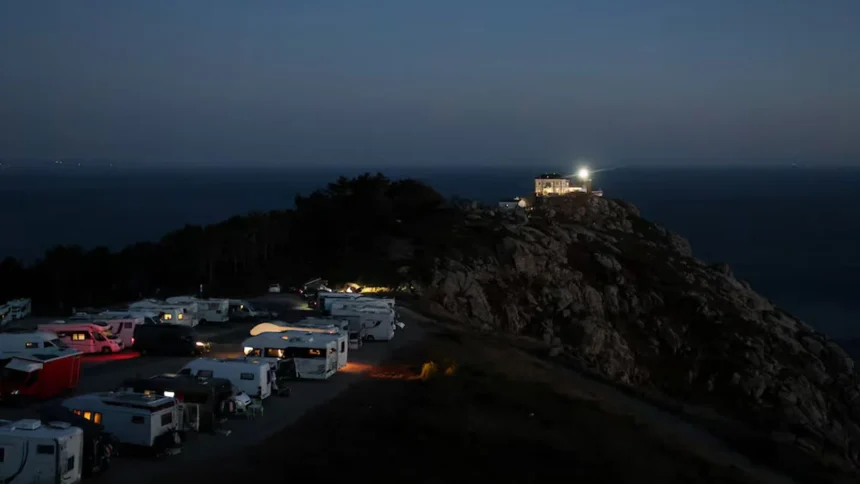
Millions of people across Spain and Iceland prepared to witness a total solar eclipse on Wednesday, with visitors travelling to prime viewing locations to experience the rare astronomical event.
Authorities in Spain expected as many as six million visitors in mostly rural areas along the eclipse’s path across northern Spain and the Balearic Islands, according to Secretary of State for Science Juan Cruz.
The eclipse occurs when the Moon passes directly between Earth and the Sun, briefly plunging areas along the path of totality into darkness. In Spain, totality will occur shortly before sunset, providing an unusual spectacle for observers.
“I hope that tonight will see the emergence of a wonderful generation of astrophysicists,” Cruz said, describing the eclipse as a particularly significant opportunity to encourage public interest in science.
The massive influx of visitors has also presented authorities with logistical and safety challenges. The eclipse coincides with one of Spain’s highest-risk periods for wildfires, prompting the government to deploy additional police and launch a public safety campaign.
Officials have urged spectators to use appropriate protective eclipse glasses and take precautions when travelling into rural and fire-prone areas.
The Spanish government also sees the event as an opportunity to promote less-visited parts of the country, potentially directing tourists away from heavily congested coastal resorts.
The Iberian Peninsula last experienced a total solar eclipse in 1912. Another will cross the region on August 2, 2027, followed by an annular eclipse in January 2028 — a sequence of events dubbed the “Iberian Eclipse Trio.”