




Punjab is responsible for the production of Pakistan’s army chiefs, prime ministers, and most civil servants. Yet, it does not create a single TV channel, a single school curriculum, or a single courtroom in the Punjabi language.
It is the language used by over forty per cent of the nation’s people — the highest percentage of any language — yet it holds no official status at the federal or provincial level. It is seldom taught in schools, rarely used in government business, and hardly ever featured in the media that Punjabis consume.
The question is not why a minority language is struggling in Pakistan — that is a story already narrated for the Sindhi, Balochi, and Pashto languages. The question is: why is the primary language struggling too, apparently at the hands of its own speakers?
The answer lies partly in the way Pakistan’s linguistic hierarchy was constructed. At independence, Urdu was declared the national language despite being the mother tongue of only a small fraction of the population — mostly migrants from India who settled in Karachi and other urban centres.
The decision was made deliberately so as not to give any single provincial language an edge, including Punjabi, within a state that was new to Partition and terrified of ethnic divisions.
However, this fear ran in only one direction. It was for this reason that Bengali nationals, who formed the majority demographic of the pre-1971 state, fought and eventually seceded.
By contrast, Punjabi speakers in West Pakistan were generally prepared to accept the dominance of Urdu. Following the precedent set over decades, Punjabi elites have been willing to sacrifice their language for power — provided that power is available in Urdu and English, rather than Bengali, Sindhi, or Balochi.
This is the class dimension that differentiates the Punjabi case. In other parts of Pakistan, language politics follows a predictable path of centre-periphery grievance: a dominant Urdu- or Punjabi-speaking centre is perceived as marginalising Sindhi, Baloch, or Pashtun identity.
Within Punjab, however, the dominant group and the marginalised group are the exact same people.
Unlike Bengali or Sindhi nationalists, Punjabi landowners, bureaucrats, and military officers never had to struggle for their language on an ethnic basis because they were never excluded from the power of the state. Instead, Urdu and English became symbols of class mobility within Punjabi society.
At home, a Punjabi family that speaks Urdu is understood to be moving up the social ladder, particularly when their children attend English-medium schools.
Meanwhile, Punjabi has become the language of the village, of the servant, of the uneducated, of jokes, and of folk songs — spoken by those deemed beneath the dignity of the literate, and holding no weight in the classroom, the court, or the boardroom.
Many Punjabi parents actively discourage their children from speaking the language, associating it with backwardness rather than heritage. A stigma usually reserved for minority languages has thus been imposed on the language of the mightiest province in the country — a stigma that was never truly about ethnicity, but about class. And Punjabi lost that battle even in its own homeland.
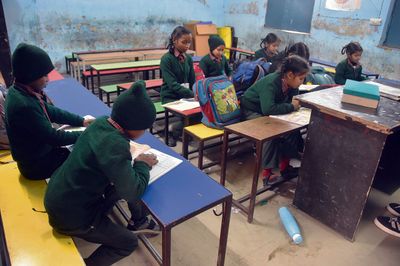
This impact is plainly visible in schools and governance. In Punjab, schools teach either in Urdu or English, with no presence of Punjabi in the curricula — in stark contrast to Sindhi, which is taught compulsorily in Sindh, and Pashto, which holds an institutional presence in Khyber Pakhtunkhwa.
While Article 251 of the Constitution permits provinces to adopt regional languages alongside Urdu, there is no Punjabi-language print press, no meaningful Punjabi news broadcasting, and no use of Punjabi in provincial courts or government organs.
While Sindh and Khyber Pakhtunkhwa have taken steps towards institutionalising their regional tongues, Punjab has not. The elite holding control over the language has no personal interest in altering a status quo that has served them so well.
Against this background, a Punjabi language movement does exist, albeit smaller and less influential than those of the Sindhis or Baloch.
For decades, organisations like the Punjabi Adabi Board, alongside individuals in Punjab’s literary and academic communities, have advocated for the inclusion of Punjabi as a school subject, its official adoption by the provincial government, and its constitutional equality with Urdu.
From Najm Hosain Syed to more recent activist-scholars, writers in Punjabi have sought to rehabilitate the cultural prestige of their language, arguing that the poetry of Sufis — from Bulleh Shah to Waris Shah — is a rich literary inheritance being needlessly abandoned.
Some progress has been made: a number of universities now offer programmes in Punjabi literature, a few Punjabi-language television and online projects maintain a presence, and discussions in public spaces have grown more visible among younger Punjabis, who increasingly view their native tongue as an asset to reclaim rather than a liability to hide.
There is a subtle paradox at the heart of all this.
Enter a drawing room in Lahore, and Punjabi is used for jokes and commanding servants; enter a gathering of poets in Lahore, and Punjabi is revered as a sacred language — the exalted tongue of Bulleh Shah and Waris Shah.
This paradox remains unresolved in Pakistan’s most powerful province: a language deemed too low for the classroom, yet too rich to abandon completely.
Punjab has not been forcibly deprived of Punjabi. Rather, generation after generation, it has simply chosen which things are reserved for pride, and which are reserved for power — consistently filling in the right column with the wrong words.
The greatest irony is that Punjab dominates the state’s institutions but not its own linguistic identity. We proudly quote Bulleh Shah and Waris Shah, yet many parents discourage their children from speaking Punjabi. A language spoken by millions deserves respect in classrooms and public institutions not just at weddings and cultural festivals.
This piece captures the topic perfectly and adds real depth. A must-read,,Thank you for sharing such valuable insights.
A fascinating piece. I especially appreciated your argument that Punjabi’s decline in Pakistan is less about state suppression than about class aspirations within Punjab itself. The distinction between pride and power is particularly compelling, and your conclusion ties that paradox together beautifully. Whether one agrees with every point or not, it’s an important contribution to the conversation on language, identity, and social mobility in Pakistan. Well done.
Another Impressive article Zoha. Your framing that Punjab’s dominant and marginalised groups are “the exact same people” completely reframes how I think about the language’s decline — power over pride, chosen by its own elites. That closing line ties it all together beautifully.