





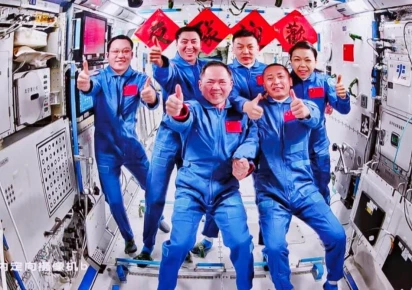
China’s Shenzhou-23 astronauts have completed a study examining how long-duration spaceflight affects the human gut microbiome as they reached their 60th day aboard the country’s space station.
The China Manned Space Agency (CMSA) said the three-member crew — Zhu Yangzhu, Zhang Zhiyuan and Li Jiaying — has also carried out a range of scientific experiments, space station maintenance tasks and in-orbit health management activities during the mission.
Using a space Raman spectrometer, the astronauts conducted research into microbiome changes and nutritional metabolism to analyse how prolonged exposure to space affects intestinal bacteria and nutrient processing.
The crew also performed force-control experiments to study changes in fine motor skills and the mechanisms of adaptive learning during extended missions in orbit.
The research forms part of China’s efforts to better understand the physiological effects of long-term spaceflight and support future human space exploration missions.