





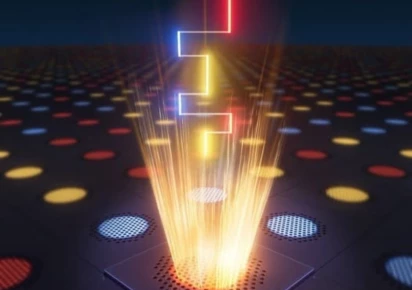
Researchers in China have demonstrated that a beam of light can be held in three stable states within a silicon photonic crystal microcavity just 20 micrometres in diameter, marking a significant advance towards practical photonic computing.
The findings, published in the journal Nature Nanotechnology, were achieved by a team from Peking University and Harbin Engineering University.
Unlike conventional electronic systems, which rely on binary “on” and “off” states, the ability to maintain a third stable state allows a single optical unit to store more information, potentially increasing computing performance and data storage capacity.
The researchers achieved the three-state, or tristable, behaviour using a switching power of just 240 microwatts, lower than the power consumption of a typical laser pointer. They also developed a prototype multi-valued optical memory device based on the technology.
Tristability is a form of multistability, in which a system can maintain multiple stable states under the same operating conditions and switch between them in response to external stimuli.
The researchers said the breakthrough addresses one of the main challenges facing photonic computing. On micro- and nanoscale chips, light exhibits only very weak non-linear effects, making it difficult to create devices capable of reliably maintaining multiple stable optical states.
The advance could support the development of faster, more energy-efficient photonic processors and higher-capacity optical data storage technologies.