





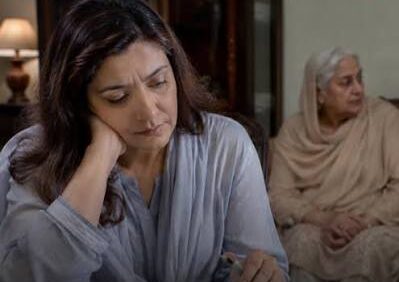
Exhibit A
Drawing room. Sometime between 8-11 pm. Over the course of the marriage (15-25 years ideally), the wife has managed the household, raised the children, handled the in-laws, maintained the social calendar, and served the emotional and physical needs of the husband throughout. Some incident has occurred. It’s not a requirement to specify what it is because that has never really mattered. The husband, half-lying on the sofa with his feet propped up on the table as he shuffles through different TV channels, talks to his wife, who is standing to the side, careful not to block his view of the TV and still trying to get him to understand that he’s made a mistake. He says:
“Mujhe afsos iss baat ka hai ke tumhein aisa lagta hai ke meine tumharay liye kabhi kuch nahi kiya”
Literal translation: ‘I regret the fact that it seems to you that I never did anything for you’
Formal Observations:
- The use of the word “afsos”, which does not exactly imply “regret” in this scenario but would translate into “what a shame”. It comes from a place of condolence, with the implied idea that the misfortune is the other person having the incorrect feelings about a certain situation.
- “Tumhein aisa lagta hai” or “it seems to you”, which entails how the subject of the apology is her perception of what he did, instead of his action itself.
- “Kabhi kuch nahi kiya” or ”never did anything”, which implies that the “apology” addresses how she thinks he’s never done anything, which implies that he has done some things, which implies that he thinks she’s being unfair.
Exhibit B
A girl in her late teens is being pestered by her parents, saying that she does not spend time with them at all. She counters them by addressing how her parents have always been emotionally absent in her life, how she cannot talk to them about anything that goes down in her day because it will just turn into another thing she’s scolded over, another thing that she won’t be allowed to do anymore because “we only want the best for you so you won’t be breathing outside anymore”. The parents start crying. Something like this then comes out of their mouths:
“Sorry beta, we are not the perfect parents. Lekin humne apni poori zindagi tum logon par laga di hai, aur tum log ab bhi khush nahi hou”.
Literal translation: ‘Sorry child, we are not the perfect parents. But we have spent our whole lives on you people, and you people are still not happy.’
Formal observations:
- “We are not the perfect parents”; this is not an admission of specific failure. It is a general philosophical justification that no parent is perfect, which is inarguable, which is exactly why it’s been chosen.
- “Lekin” or “but”; one word. The apology lasted exactly one sentence before the pivot. Note the speed.
- “Humne apni poori zindagi tum logon par laga di” or “we have spent our whole lives on you.” The injured party is now the accused.
- “Tum log ab bhi khush nahi hou” or “you people are still not happy.” Still. The word implies a history of ingratitude predating this conversation. This isn’t the child’s first offence of asking for something from her birth-givers.
Exhibit C
Government minister, dressed in a perfectly tailored shalwar kameez and a waistcoat, sitting in a press conference panel, with a bunch of politicians from his party by his side. The press conference is a result of multiple accusations and high court cases for money laundering, illegal assets, unfair use of power, and sexual harassment/assault allegations by multiple women. The journalists ask a list of questions, but the minister of the state answers only a few, which the politicians by his side decide are appropriate. The questions that attain the honour of being answered are answered in a way that makes the journalists wish they had refrained from asking them. At the end, the public apology arrives, and it goes something like:
“Mein maazrat chahta hun agar kisi ko mere kaam se takleef pohanchi hou, lekin sabb jantay hain ke mere liye meri awaam ki khushi se zyada aur koi cheez matter nahi karti. Jo marzi aap social media par propaganda phela lein, jitney marzi aap court cases chala lein. Mera Allah mujhe jaanta hai, aur meri awaam mujhe jaanti hai.”
Literal translation: ‘I apologise if anyone was hurt by my actions, but everyone knows that nothing matters more to me than the happiness of my people. Spread whatever propaganda you want on social media, and file as many court cases as you like. My Allah and my people are my witnesses.’
Formal Observations:
- The use of “if” when apologising, implying an internal inclination towards the belief that the actions hurt no one.
- Mentioning how everyone knows that the happiness of the public matters most to this person; implying assumed knowledge regardless of whether there is supporting evidence in the actions or not.
- Adding how God sees the true intention of a person, shifting the accountability court to only the divine.
The observer wishes to place on record that no specific individuals were intended in the above analysis. Any resemblance to actual apologies, living or issued, is entirely a matter of grammar.
Excellent effort
Keep it up