





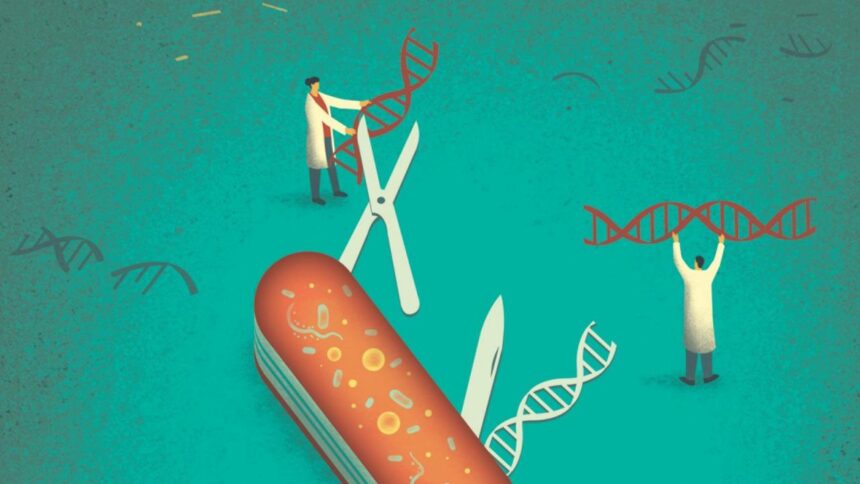
We live in a time of rapid advancements, modern technologies and AI, where medicine and biology are not just reserved for pills and physical treatments but now explore the intricate techniques of gene editing and manipulation.
Technologies such as CRISPR, TALENs, and Zinc Finger Nucleases (ZFNs) are revolutionising medicine in ways that once seemed impossible. The predictions about gene manipulation and editing are not just a mere dream, but they are quickly becoming a reality.
In 2019, the first-ever CRISPR treatment was given to treat sickle cell anaemia — a genetic mutation that affects the structure and function of red blood cells. The CRISPR therapy for sickle cell anaemia has since been approved by the U.S. and the U.K. Before CRISPR the only available aid was a complete bone marrow transplant, a procedure that is expensive, risky, and often difficult to access.
CRISPR stands for “clustered interspaced short palindromic repeats”, a natural mechanism that helps microbes fight against invading viruses. To treat genetic disorders, scientists pair a CRISPR-associated enzyme with a guide RNA that directs the enzyme to a specific section of DNA. The faulty genetic sequence can then be edited with remarkable precision. It is similar to removing a thorn from a rose, but on a microscopic scale. Like snipping off the thorns of a rose but on a microscopic level.
This technology is fairly new, only ten years into its development, and already it has shown remarkable results. In 2020, the Nobel Prize in Chemistry was awarded to Emmanuelle Charpentier and Jennifer Doudna for CRISPR development.
Gene editing and modification have always been a possibility everybody likes to discuss. In dystopian novels and fiction, it is often seen as an ethical dilemma where the lines between medical treatment and human enhancement seem blurry. Critics argue that editing genes is equivalent to interfering with nature itself.
However, bioengineer Stanley Qi explained in an interview with Stanford Report that gene editing treatments have 3 divisions: the cure, prevention and enhancement. The cure is purely ethical with no harm done to any person. The prevention falls into a grey area and is only acceptable when there are no other treatments available. While enhancement is an unethical path, that not only would create unfair advantages for certain individuals but might also lead to new genetic mutations in future generations.
Now it is clear that the idea of wanting to completely modify and design your body is not only unrealistic but also dangerous because our body is a complex system of cells, genes and molecules; even a minute change in the genetic coding would have wide-ranging and unpredictable effects.
The future of gene editing has immense potential to treat diseases like Parkinson’s, Alzheimer’s and leukaemia — diseases that affect millions of people worldwide. Not only that but it could also help in ecological, nutritional engineering and sustainability. Like enhancing crop growth or bringing back extinct organisms
Whether gene editing ultimately fulfils its potential will depend not only on scientific progress but also on humanity’s ability to navigate the ethical challenges that accompany such powerful technology.