





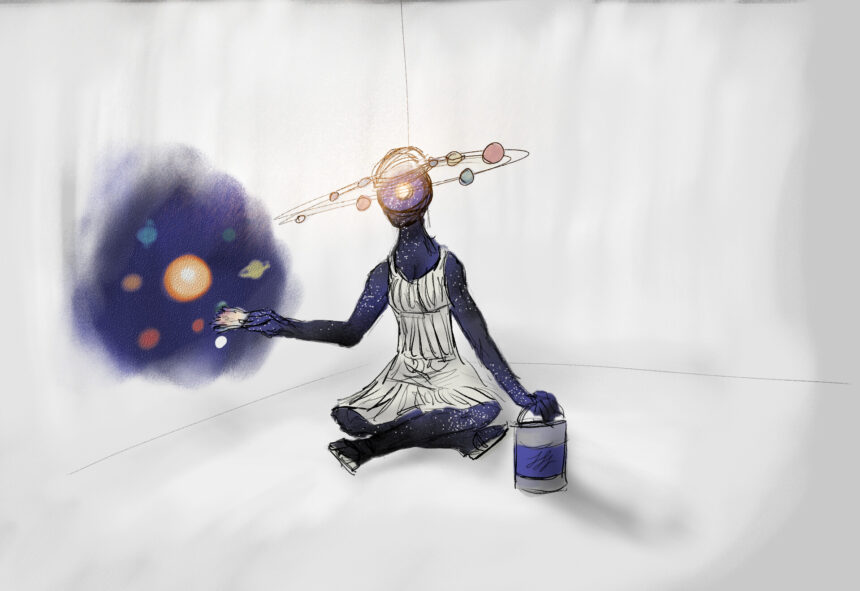
Imagine you sat together with a friend who just brings bad news. Their face crumbles. Their voice breaks. You have an instinctual or automatic desire to reach out, for this is a situation you know. You want to console them; you have an idea that they suffer; you MUST say something for them — this is why it is automatic. But there is a philosophical question that has not been answered clearly and completely so far: How really do you know?
You have NOT experienced their afflictions. This is the only one you’ve ever known.
You don’t have to be a conquering hero to tell you how to tell that your friends are crap. The problem of other minds is one of the oldest unsolved problems in the philosophy of the mind. Theoretically, it might just be a predicate dispute in a dusty lecture hall among fierce academics, but with the days of computers talking to computers, computers doubting themselves, and computers creating, unexpectedly, empathy, it’s a pertinent question.
Where Does It Begin? Descartes and the Isolated Mind
Making this problem difficult is what is hard — the fact that it is so hard. It takes a journey back some 400 years to find a French philosopher who was sitting by an image by a fire, attempting to disbelieve everything.
In his Meditations on First Philosophy (1641), René Descartes began his quest to discover something, anything that he could not doubt. He doubted his senses: he was not sure whether the senses deceived him or not. Not quite sure of what was out there (may have been a dream). He could not guarantee it; there were others out there. He hadn’t been certain about self-doubt. Thinking was happening. So someone was thinking. I think, therefore, I am confident. I think, therefore, I am confident.
This was the one thing that he was sure of: his mind.
But everything else that he sat on, everything else in front of him, everything else that he had ever met and met before, and everything else that he met, philosophically speaking, was uncertain. He couldn’t get into someone else’s head and check to see if anything was going on in there.
Enter Solipsism: The Position Nobody Wants to Take Seriously
Solipsism (from the Latin solus (alone) and ipse (self)) is the philosophical concept that the self is the only thing that can be known to exist. At its most extreme, it implies that the whole outside world, including other people, may be a figment of one’s imagination.
Everyone listening to this will just say, ‘Get real!’ There are others out there, too. They are, of course, aware. If you didn’t, you would be in a state of madness.
However, here’s the issue — that’s not a philosophical argument. It is a response that is emotional.
There are two types of the role, and it’s crucial to differentiate them. As extreme as philosophical solipsism, the belief that only one thing exists, which is me, called metaphysical solipsism, is practically never held by any serious philosopher. The recognition that you cannot know if other minds exist, however, is much more defensible and much harder to reject, and here we have epistemic solipsism. It’s not necessary to believe that nobody else is awake. All you need to concede is that you can’t prove they are.
The Standard Responses and Why They Are Not Quite Enough?
There have been some important attempts to solve the problem of other minds in philosophy. Each is worthy of its merits. Each of them also has a big box of problems that is usually overlooked.
The Argument from Analogy
The one most often attributed to the 19th-century philosopher John Stuart Mill is something like this: I know that when I am in pain, I cry out and react. If I see someone else crying and recoiling, the best bet is that they are also in pain – they’re showing me what I’m experiencing, and I can see that in myself.
It sounds persuasive. The issue is that this argument is based on a one-person sample. You are making an inference about a general principle: that behaviour X is related to inner experience Y, based on one data point, namely, yourself.
Behaviourism
A very influential concept in 20th-century psychology and philosophy that sought to eliminate the problem by redefining consciousness. If the reason why you’re in pain is simply that you’re behaving in ways that are characteristic of a person in pain, then, if others are conscious, they’re simply behaving in ways that are characteristic of a person in pain, and it’s not a question of whether they experience pain or not.
The philosophies of most of the philosophers have been discarded and rightly so, since behaviourism has been a thing of the past. It’s a feeling that is difficult to put into words, but it’s easy to describe: It just feels wrong. Suppose a creature reacts to stimuli in the same way as a human reacts to pain, flinching, crying, and saying “That hurts” but having no pain inside.
The Best Explanation Argument
It’s a more utilitarian view: the easiest theory about human behaviour is that people have inner lives. The simplest assumption is to think of consciousness in other people.
That is fair, but simplicity is equated with the truth. The history of science is filled with such theories: the simplest explanations of the time, which were subsequently found to be incorrect. The rule of simplicity is a good one. Not a sure thing.
There is no point in any of these answers. However, if you examine them carefully, none of them actually provides a solution to the problem. They justify belief in other minds. They render belief in other minds reasonable. They don’t prove it.
What Does It Mean to Sit With the Uncertainty?
I don’t think you will have to cease to care about others to take epistemic solipsism seriously. It’s not asking you to go into isolation or to be a philosophical chair. It will take a bit more nuance and, indeed, a bit more honesty: accepting the fact that you do not have evidence for the existence of other minds, only faith.
The foundations of our social world, our moral commitments, and our legal systems are not the philosophical certainties about other minds. It is an unassuming, unchosen, very human assumption that other people feel, suffer and experience. We assume this is true. It is not. For most of human history, that was not a problem, for the entities to which we were trying to extend our consciousness were biological, like us.
The AI Moment: When the Problem Became Impossible to Ignore
The British mathematician Alan Turing, in 1950, published a paper, Computing Machinery and Intelligence, in which he proposed what he called the imitation game — now known as the Turing test. The concept was simple: If a machine could communicate with another human being in a manner that would seem indistinguishable from human communication, it would be intelligent.
Turing’s test was much hailed. From the point of view of the problem of other minds, it was also patently flawed, assuming that passing behaviour would provide enough evidence of inner experience. But we have just witnessed that such an assumption is doubtful. The problem of other minds is the problem of the difference between behaviour and inner experience. And the Turing Test is only about behaviour.
Moving on to one of the most impressive thought experiments in modern philosophy, David Chalmers presents it in The Conscious Mind (1996). Chalmers invited us to consider a philosophical zombie, not a zombie from a horror movie, but one who is physically and behaviourally just like a human in every way but who lacks any inner experience whatsoever. No sensation. No feeling. It is just nothing like being them. The lights are on, but the people aren’t!
The important thing is you wouldn’t have known it from the outside.
Then think of an elaborate language model. It generates sensitive answers that are contextually relevant and, at times, shockingly human. It can be unsure, modify its statements and react to emotional signals. If it is conscious, it gives thoughtful, hedged answers when asked.
So far, we have always given other humans consciousness for two reasons: because of their behaviour and their construction. Up to this point, we have granted consciousness to other humans under two conditions: they mimic our behaviour, and they are constructed like us. AI systems are becoming increasingly adept at meeting the first condition. They are not the second criterion. No one has yet convincingly shown that consciousness requires biology, however, in any place where it has been attempted. We have assumed it. It has not been proven.
Why Is This Not Just a Philosophical Puzzle?
A cynical reader might well ask at this juncture, ‘So what?’ While we may not be able to prove that there are other minds around us, we are perfectly capable of going about our daily lives; we make the assumption. So what does this mean in practice?
It is important because the beliefs we hold about consciousness are not just philosophical but the basis of our moral and legal laws.
Human rights are based on the assumption that there are inner lives to humans — they can suffer, and their experiences have moral meaning. When we’re not able to explain why we think this is true, or why we give it to somebody or why we don’t give it to somebody, we’re not as confident as we’re supposed to be in our frameworks.
The European Union’s AI Act (2024) is the first sign of a law attempting to regulate AI systems — albeit very narrowly, essentially disregarding the question of machine consciousness and grounding it on risk and capability instead. This is functional and could be short-lived. As artificial intelligence systems become more complex, eventually courts and legislatures will have to confront issues the philosophers never faced: can a machine suffer? Is it interested in anything? Should it be protected?
The Leap We Make Every Day
No tidy resolution for us here. Solving the problem of other minds has not been solved. This essay probably won’t solve it, if indeed it is possible to solve it with an essay.
Yet, this is exactly what they’re trying to do.
The next time you are faced with a person in pain, a person who sees their face crumble and whose voice cracks, you will reach out. You will do it without hesitation and without referring to a philosophy book or asking for proof of their inner experience.
It is not an irrational instinct! It could be a true statement. Yet it is a choice, a choice that is made in the face of uncertainty, a choice based on faith, not on proof. And knowing that sitting with the reality that our base assumptions about society are leaps, not certainties, is not a reason to doubt others.