





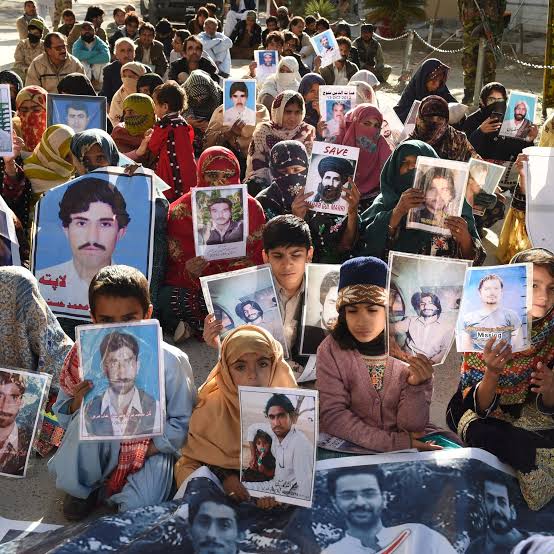
In Balochistan, a province rich in natural resources, the Pakistani state has long since established a filthy but formal legal mechanism of abduction and detention while being accused by international observers and human rights groups of orchestrating a systematic campaign of enforced disappearances (Provincial Assembly of Balochistan, 2025; Asian Human Rights Commission, 2011). The issue is deeply complex due to the conflicting narratives presented by human rights groups and the Pakistani state.
The crisis unfolds at a very large scale. However, the exact number of documented disappearances in official and non-governmental figures differs. From January to June 2025, around 814 cases were documented. In July 2025, 112 cases and, in April 2026, about 124 cases were reported (Human Rights Council of Balochistan). In contrast, the Pakistani govt’s Commission of Inquiry on Enforced Disappearances reports that out of 10,636 cases received since 2011, 8,986 have been resolved, with 1,650 still under investigation.
While victims come from many walks of life, students, labourers, drivers, and shopkeepers are frequently reported as targets; it also includes the abduction of minors, with 52 children reported missing in the first half of 2025. The majority of enforced disappearances occur through direct house raids.
The most critical aspect is the battle of narratives that creates a deep divide between human rights organisations and the Pakistani government. The groups, e.g., HRCB and BYC, spread the stance that innocent civilians are being forcibly disappeared in a systematic campaign of repression. While the govt. of Pakistan stands firm on the stance that this is mere propaganda, spread to gain sympathy for terrorists, especially groups like BLA, funded by India to destabilise Pakistan.
The legal system has been active, though its credibility and effectiveness are debatable. Instead of resolving the case, the state has been using the legal framework to legalise its wrongdoings. The Anti-Terrorism Act, 2025, passed by the Balochistan Assembly grants sweeping powers for warrantless arrests and 90-day detention without trial, which could worsen the situation. The Supreme Court has a long history of involvement since 2012, when it declared the govt. Duty-bound to protect citizens and recover missing persons.
Documentation and court testimonies point to high-level figures within state security institutions as the originators of these orders. In a significant case, an FIR was filed against the heads of ISI and MI for the abduction of a man named Ali Asghar Bangulzai. Beyond specific names, the system, comprising Frontier Corps (FC), intelligence agencies (ISI, MI, and IB), and the Counter Terrorism Department (CTD), is cited as the orchestrator (Asian Human Rights Commission, 2011).
The administrative process is also a system of denial and legal manoeuvring rather than a transparent chain of command. Officials from the Judicial Commission admit that the agencies’ denial of keeping persons with them is a stereotyped statement. Also, the responsibility of appearing before court is typically delegated to lower-level officials who lack power and knowledge of the persons and also act as a buffer between agencies and the judiciary. This prevents public accountability.
The persistent gap between judicial attention and actual accountability in Balochistan’s enforced disappearances crisis is deliberate. The system is not failing but being designed to produce the appearance of justice through commissions and court orders, shielding the institutional machinery responsible for the crisis. The gap has persisted for long due to the legal “cover” such as the Anti-Terrorism Act, 2025. The state redefines the problem as solved. The govt’s strategy includes declaring victory while violations continue. Even when courts intervene, accountability remains elusive. Security agencies provide in-camera briefings, barring public scrutiny. The govt and militant narratives have become weaponised. State officials dismiss disappearances by calling them propaganda or claim missing persons are “terrorists.” The institutions responsible for the disappearances are the same institutions courts must rely on for evidence and enforcement. The Commission of Inquiry can document and “dispose of” cases, but without power to compel intelligence agencies or prosecute Frontier Corps personnel, it operates as a mechanism of managing, not closing, the gap.
Im proud of you this is really well written ,great work ,impressive writing ,very thoughtful ,well done this shows alot of effort you explained this so well honestly impressive again very proud of you❤️👍🏻
Love every single word. Too good❤️