





Do you remember the times when you would look forward to weekend “pizza nights out”? Where you would sit around the table with all your loved ones. The excitement in your voice when you pointed at the huge pizza with Coke and the anxiety that hit your feet while you waited for the waiter to show up with your food – do you remember them? Now it’s no longer “pizza nights out” but “pizza nights in.” You sit comfortably on your couch, browse through your menu, and tell your waiter what you want on the phone, then press pay, and your food starts to make its way to you. An interesting fact is that some of the restaurants you order from might not actually exist; these restaurants are referred to as “ghost” kitchens. Not because ghosts prepare those dishes; allow me to explain it to you. It may seem like a quick way to get your food fast, but so many things are affected; for example, restaurants and food are part of the community and how it’s built, as they are spaces where people meet, interact and make memories. So, what actually happens when these spaces become invisible digital brands?
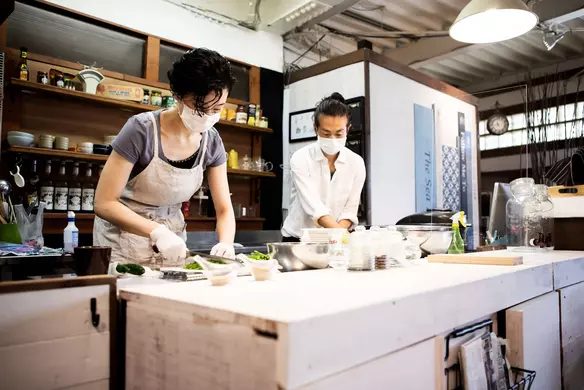
Ghost kitchens, also known as ghost restaurants, cloud kitchens, or virtual restaurants, are kitchens with no shopfronts or physical locations for customers to dine in. They are designed to focus on takeout food and deliver it to the location where it is. They are able to operate multiple virtual restaurant brands within a single kitchen space with the same equipment and workers but marketed differently to customers. According to the Menubly article by Taylor Anderson, “These kitchen facilities can be standalone operations or part of shared commissary kitchens where multiple food brands prepare their menu items in one central location.” A simple example is a restaurant that prepared and sold your favourite beef steak can also be the one that made your favourite pasta. Even though they have been there since 2017, they gained their popularity during the COVID-19 era, when everything was shut down. These delivery apps became restaurants that people relied on to get their favourite dishes right in front of their doors. While these save time for you and money for the owners, what do they do to our community, to the physical restaurants?
The fact that one kitchen can make food for multiple restaurants with the same equipment and workers shows that food is no longer about creating human connections, showing love and passion in the preparation of food and the anxiety of waiting and the excitement of receiving your order; it is now about getting it quicker and cheaper. What happens to the pride and passion that chefs felt when someone said “compliments to the chef” and to that one restaurant that had secret recipes, the only restaurant that prepared that delicious soup you like? I mean, for the longest time, food has been part of our culture and community, and physical restaurants have been places where we met people, where we celebrated our victories, and where we made our relations stronger. Now, with the rise of ghost kitchens, what happens to this culture? Instead of hearing laughter and loud conversations while you wait for your food, all you hear is a notification alerting you that your food is here, right there in front of your door. What does this mean to our communities? Can we still be a community with a food culture when restaurants become invisible warehouses with no windows, chairs, or tables?
Culture and food go hand in hand, so if food is produced in the same restaurant by the same staff and equipment, of course, they will taste the same but with different brand names. These restaurants begin to resemble factories, producing standardised meals under multiple brand names. We can compare this to the production of the clothes that we wear, which also look the same but have different brand names; food also then becomes mass-produced and endlessly replicated. In this way we lose those dishes made with secret and fresh ingredients and the choice to have the same dishes that taste differently and the choice to be creative.
Lastly, while people support ghost restaurants, traditional restaurants may be badly affected economically: no customers means no income, which may result in the restaurant closing down and people losing their jobs, while ghost restaurants benefit financially and continue to grow. This is also how the traditional restaurant ceases to exist.
As much as ghost restaurants are good in saving time and money, we should ask ourselves, what actually happens to restaurants that used to be places where we celebrated our triumphs and victories with our favourite dishes in front of us and become invisible digital brands? Can we still be a community with a food culture?