





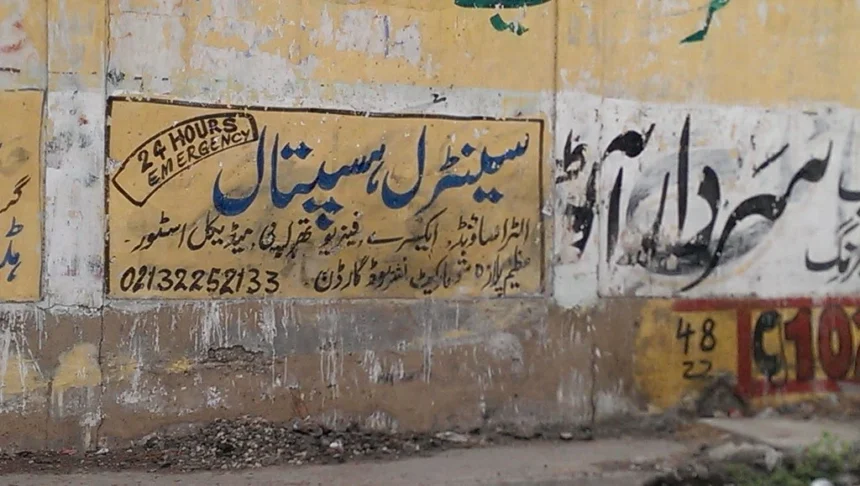
If walls could talk, they would tell stories history forgot to write.
The walls of Pakistan have always been beyond the concrete and the paint. They carried catharsis, advertisements, and slogans. And all it required was chalk. But somewhere between the age of chalk and the age of touchscreens, these voices eventually faded.
As a child, walking through the narrow alleys had always been a source of fascination. Filled with advertisements of herbal physicians claiming to treat incurable diseases, and the poetry of people who wanted to be seen without taking accountability. Though most of the things written were exaggerated and rather embarrassing. Yet nobody cared. Because this “ancient Twitter” carried no usernames. A place closer to home — where one could write all that one desired without having to explain what one meant.
Now the algorithm has joined the table — deciding who deserves to be heard and seen. The walls that once carried countless voices were slowly stripped of their purpose, as owners guarded them in the pursuit of cleanliness and social elegance. For the sake of sophistication, the society unknowingly silenced the newly emerging voices.
Above all, the wall chalkings and paintings teach us one clear idea: no matter in which era a person was born, they had an inner desire to be noticed. Before social media came to life and earned its name, people diverted others’ attention through these walls. Human beings have always searched for surfaces upon which they could write themselves into existence. Yesterday it was walls; today, it is screens. Though the medium has changed, the need to be heard remains the same.
These silent yet echoing walls gave freedom of speech to everyone equally. Now, reach is bought, and beliefs are built. However, social media cannot be overlooked. It expanded the boundaries of human expression. The walls of a city could speak to a community, but the digital world allowed a single voice to travel far beyond the streets where it was born.
In the digital world, fonts are used as a means of carrying the message. Though it may seem normal, it conceals the emotions that were present when they were written. A sentence that was written with frustration will appear the same as a sentence written out of joy. The wall chalkings not only conveyed the message but also delivered it with the same emotions as they were written. Each handwriting added authenticity; each bold letter would randomly pop up in one’s mind in sorrow.
Perhaps the question was never whether wall-chalking or social media was more important. The question is whether progress should require the abandonment of what once gave people a voice. Social media has expanded the boundaries of expression, but in the process, we should not allow the streets to lose their language entirely. The walls that once carried stories, emotions, and resistance deserve to remain more than silent concrete structures. Rather than replacing one with the other, society should revive the spirit of both — preserving the human authenticity of the walls while embracing the limitless reach of the digital world. A voice, after all, deserves not only to travel far but also to feel real. The walls may fade, and the screens may evolve, but voices are timeless.