





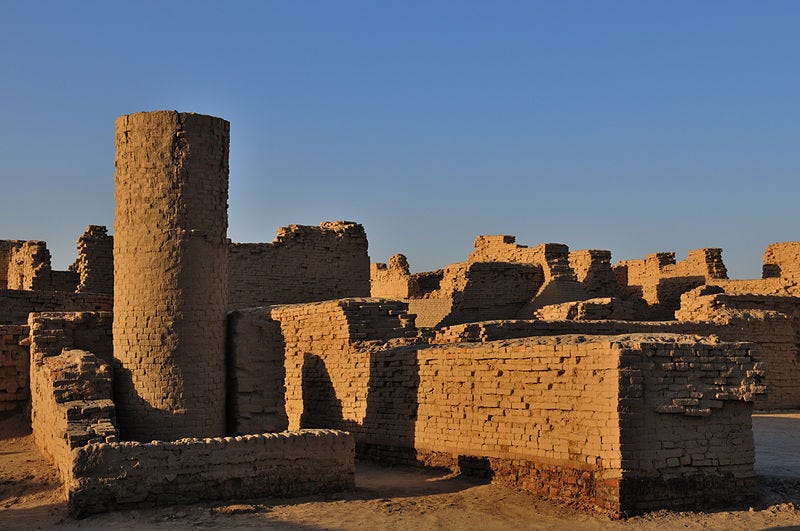
A civilisation that mastered water 4,500 years ago was eventually broken by its absence.
Mohenjo-daro is a group of ruins found on the right bank of the Indus River in southern Pakistan. It remains one of the most remarkable cities of Pakistan. It was at its peak around 2500 BC, with a population of 35,000 to 41,000. These people lived in a network of streets, baths, public wells, and sewers. It consisted of large buildings, residential areas, halls, and ceremonial assemblies. It was made in such a way that residents were protected from extreme weather.
The Great Bath House of Mohenjo-daro remains one of the most fascinating archaeological sites, as the biggest house in the town wasn’t a palace or an assembly hall; it was a bathhouse for the public.
Unlike most of the civilisations that revolved around the concepts of agriculture, religious beliefs, trades, and wars, the Indus Valley Civilisation revolved around water; it was organised around it. With a basic understanding of harvesting, cleaning, draining, storing, and using it, they operated their systems without any difficulties. Water was considered an advanced system.
Around 1800 BC, the cities were abandoned, and people left. The cities fell apart, and gradually people migrated.
Often said to be the ‘hydraulic civilisation,’ this civilisation had a simple concept: water supply as the heart of the city. As water was the main source, people resolved their whole lives around it. The reason for the decline of the civilisation isn’t clear, yet historians have come up with multiple theories. Many theories, like the invasion of tribes, movement of the tectonic plates, shifting of rivers, and climate change, were put forward. Others cited the slow drying up of the Ghaggar-Hakra River, which was a main source of water for the Indus Valley civilisation, as contributing to the decline. Some studies suggest that a drought from Tso Moriri Lake in Ladakh, which lasted about 900 years, may have been a factor. Other factors included less harvesting, food scarcity, and declining trade. The economy collapsed, and eventually people shifted.
At the centre, Pakistan’s current system runs on the water from the Indus River deeply. About 80% of Pakistan’s irrigation water is drawn from this river. Around 200 million people depend on it for hydropower generation. Compared to the US, which stores around 900 days’ worth of annual runoff, Pakistan only stores 30 days’ worth of runoff. The problem took a serious turn when, in the winter of 2024-2025, Pakistan faced its driest season; a 67% rainfall deficiency was observed nationwide. Mohenjo Daro faced a 90% decrease; agriculture went down by 67% because people/farmers did not participate. The same year, India suspended the Indus Water Treaty because of military tensions. At that time, it became clear that the water we depend on for day-to-day use is someone else’s leverage.
The lesson that we learn from the Indus Valley Civilisation is that even the glorious sites will face a downfall if the civilisation is oblivious to it. Pakistan is a country with infrastructure, relations, and organisations, but the country is going through a water scarcity issue, mostly due to flawed systems and negligence. The people of Mohenjo Daro had no access to advanced systems, weather forecasts, climate models or the latest technology, but we have them all. We have data to support our analytics.
The disappearance of Mohenjo-daro was gradual and slow; the collapse happened slowly. Rivers shifted, new systems arrived, and previously used ones became impractical, and climates shifted rapidly. The world’s most glorious urban civilisation came to an end and wasn’t able to sustain life anymore.
Today, Pakistan faces the same situation; the Indus River is declining. Climate, floods, droughts, waterlogging, salinity and extreme use of land have given rise to shrinking food production and availability.
Mohenjo-daro stands as evidence of what could happen if patterns are repeated. Given new technology and systems, we can easily protect our country against increasing water scarcity, as what was once thought of as unlikely to happen is happening right in front of our eyes.