





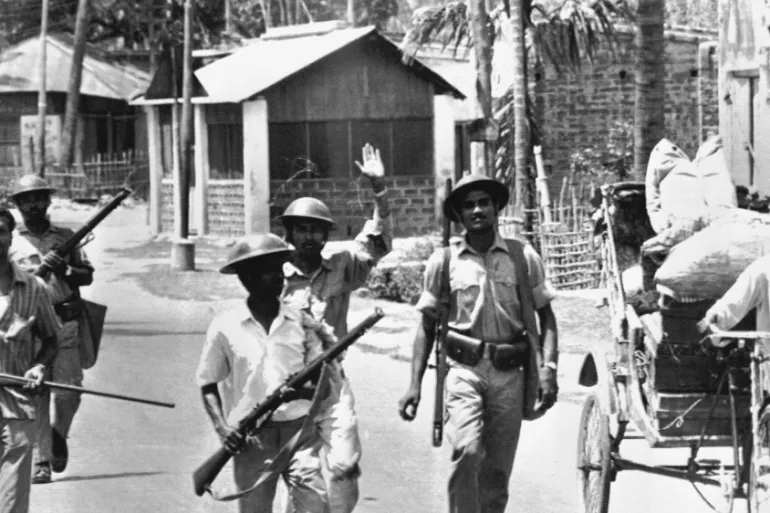
Some stories echo through generations, and some fade into silence either by choice or through propaganda. History inherently is a weapon used by authorities to change narratives, build identities, and unity, and most importantly, political stability. This may be in the form of bias and censorship, which takes away the right to question and instead believe what is told. The events surrounding the catastrophe that shook up the entire geographical and political dynamic in South Asia in 1971 remain a prime example of how the words were twisted and the accounts were changed by each nation.
Now the question remains: to address it or give in to the “1971 silence”? The event transitions into a representation of liberation and independence for some and a tale of loss, failure and separation for the others. And this tale couldn’t have been worded better than how Naseer Turabi did in his ghazal “Woh Humsafar Tha,” quoting:
عداوتیں تھیں، تغافل تھا، رنجشیں تھیں بہت
(There were hostilities, neglect and grievances.)
بچھڑنے والے میں سب کچھ تھا، بے وفائی نہ تھی۔
(but the one who separated had everything but betrayal)
History is very rarely written in isolation but instead is deliberately constructed on the narratives of heroism, survival and sacrifice post-war. This is a common occurrence throughout the timeline of South Asian history. Nations choose selective remembrance of certain events that suit their narrative and neglect the rest. This process, however, is entirely mundane as societies seek stories that maintain coherence. Yet again the consequence of doing so is always the “uncomfortable” questions not being answered even after decades.
The events of 1971 emerged as an aftermath of rising tensions between East and West Pakistan post the war of independence in 1947. Despite geographically being the same nation, the regions were separated by a vast land of the Indian territory and hence had different experiences in terms of culture, language and even politics. As time passed, the conflict about representation, economic distribution and cultural identity increased.
The elections held in 1970 are marked as the main road towards dispute. The Awami League gaining victory in the east created expectations of political transition but was overlooked, and the negotiations failed, planting the seed of mistrust and change in general consensus amid the already recurring instability. What unfolded next was beyond what each side fathomed. A mass conflict instigated by military operations, resistance and displacement. And what happens when a country is put through turmoil and becomes vulnerable? Unwanted intervening, in this case it was by the hands of India. What started with political clashes ended with a declaration of the independent state of Bangladesh.
The accounts archived in historical records bear witness to the controversy and its mass effect on the civilians. Whenever there is a lack of cohesion, a difference in opinion emerges, and in this case it was in the form of viewing the event through different lenses by the journalists, scholars and various mediums of commentary. Three nations and three distinct perspectives: Bangladesh saw it as a fight for representation, India as a humanitarian crisis, and while discussions in Pakistan even after all these years stay politically sensitive and restrained.
This restraint has often been worded as the “silence,” despite the reality being far more complex. Silence in history is restrictive, not being absent but also not fully expressing, and it can appear through omission, cautious language and limiting public debate. The series of events is conclusive, keeping some episodes fully studied and investigated while the others are kept away from the mainstream in educational and public discourse.
A list of factors contributes to this silence. When societies emerge from a painful conflict, they often avoid revisiting the incidents to avoid exposing institutional setbacks and, in some cases, atrocities.
Educational institutions are often seen reinforcing whatever we are made to believe by shaping a collective memory, especially through curriculum. And since perspectives of each side are difficult to compile in textbooks, generations down the lane may have a partial understanding of the past and may overlook what the neighbouring countries remember it as. Media and public commemoration further endorse this with national holidays, films and documented data shown in museums. Whatever is memorised publicly becomes central to identity while the rest recedes from popular consciousness. But despite this, the truth evolves and finds its way onto the surface by the archival access, political climates and generational changes.
In recent times, however, this narrative has transitioned towards a broader historical engagement, and scholars all across South Asia have been exploring personal testimonies and archival documents for a rather comparative perspective on this war. And this eventually encouraged more nuanced conversations that move past the limited narrative.
Although one should take note of the fact that this does not require abandonment of any patriotic sentiments, but instead this inquiry allows societies to acknowledge complexity, as many other countries have also undergone the same process regarding wars. However, the real challenge lies between history and memory, where the former is backed up by factual data, while the latter is overruled by emotions. A nation’s history examines ambiguities, while memory, on the contrary, emphasises unity.
Hence “the 1971 silence” reveals something more than a historical debate and demonstrates how nations construct themselves through storytelling by deciding what to mourn and what to celebrate. Yet the silence is never permanent; archives reopen, new generations question the authorities, and the voices silenced earlier rise once again in search of answers. No matter how uncomfortable the process is, it is vital in understanding the human dimensions of history.
Ultimately, the study acknowledges the universal relationship between nations and memory. That is how history edits itself. But what truly matters at the end of the day is to not blindly follow what is being fed without broadening your ability to digest other aspects of the event and revisit these with humility, curiosity and honesty.