





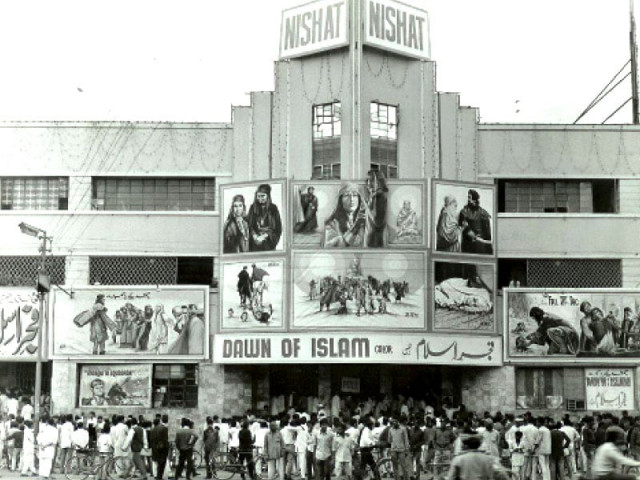
There once was a time when the lights dimmed slowly inside Nishat Cinema. Crowds lined up outside the cinema, a restless energy that settled only when the screen came alive. People shared the experience of film-watching. Today, Karachi has stopped making a space for cinemas; they have either vanished or been replaced by the malls.
Cinemas like Jubilee Cinema, Capri Cinema or Kooh-e-Noor were never urbane. These places were always crowded and noisy, alive in such ways that cannot be found in modern cinemas. People from all social classes, workers, students, families, and friends occupied the same seat. Boundaries of classes blurred, and people came together to watch. In this form, cinema functioned as one of Karachi’s few democratic cultural spaces, where social hierarchies didn’t exist. It was a collective memory, bound by the simple affordability of tickets, that made the experience special.
The decline of cinema can be traced back to the era of Zia-Ul-Haq. Media and entertainment were targeted greatly, as they became a tool for religious programming. Strict laws and censoring, only in favour of shows that had moral and ethical values aligned with Islam, were aired. With the increasing limitations, cinema collapsed. It was around this time that the quality of Pakistani cinema started to decline, with low-budget production and old narratives. Slowly cinemas started becoming irrelevant and not realistic; the audience was lost. These changes reshaped media and entertainment in such a way that we didn’t get them back. The golden age of Pakistani cinema came to an end as the content and passion for film-making weakened.
As Karachi transformed, the conditions for cinema’s survival also took a new shape. With the rising political unrest, conflicts, gangways, and cycles of violence, the film industry began to gradually change. Everyday life was reshaped through strikes and shutdowns. The need for pleasure was overcome by the terrors, and cinemas were abandoned. With little protection and neglect, public venues became easy targets. Firstly, families stopped going, shows were shut down, owners sold their venues and the maintenance declined. The shift wasn’t overnight; firstly, it became a part of the routine, and then the fear settled in. Gradually the audience decreased; cinema culture wasn’t able to survive in such circumstances.
Another aspect here is reconstruction. The old cinemas were deconstructed to make spaces for shopping malls and plazas. This entirely changed the landscape and need for pleasure. Given the security concerns, people preferred places with no threats and provided security. The malls ensured security and reduced risks, in contrast to the uncertainty of other public places. Hence, the multiplex became a safe place in an increasingly insecure city.
Like everything, multiplex culture had its own drawbacks. Multiplexes offered premium prices and controlled environments, but they became more exclusive. Earlier cinemas were public but flawed. The change from cinemas to malls redirected cinema forever. Cinema became exclusive; it was changed forever.
This shift also had its social implications. Historically, cinemas were affordable but often had a male-only culture. They were unwelcoming to women and families and often raised safety concerns. Multiplexes, on the other hand, were safe for women and families. This allowed women to take part. As nice as it sounds, the safety and social inclusion had a price which was premium. Women from upper social classes were able to take part in it, but the women belonging to backward backgrounds were once again left isolated.
Meanwhile, the entertainment industry was also rapidly changing. In Pakistan, entertainment shifted from outdoors to indoors. With the advent of cable, DVDs and then streaming media, people no longer felt the need to go to the cinema. They were able to get the experience in the comfort of home instead of going out. In this way this shared experience also became isolated and individual.
In between these tides, the crowd also changed. The millennials who used to enjoy and engage in cinema were replaced by Gen Z, who preferred online streaming platforms. It was the crowd, the responses of the audience and the sense of being part of a community. Cinema-viewing became a solitary experience, even if it was done in a crowd.
What was lost in these shifts was never to be found again. The entertainment industry changed forever, and somewhere along the way, it lost its essence. If we stand in the place of Nishat Cinema today, it would be hard to imagine the chaos, the clutter and the people. All of it is now gone, never to be found again.