




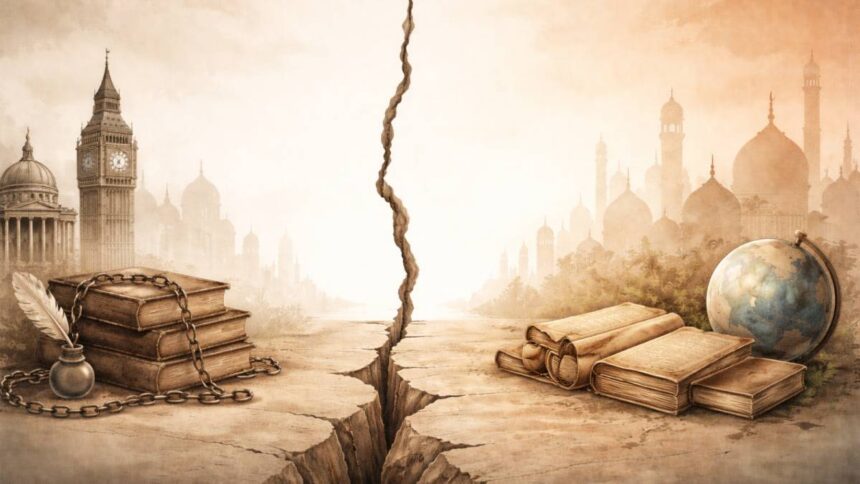
Most Pakistanis did not know that a language like “Shina” existed in the mountains of Pakistan until Hassan Raheem sang with it in a mainstream song. That got me thinking, how many regional, unknown, and possibly dead languages do we not know about? Modern Pakistan mainly focuses on two languages: Urdu, our national language, and English, our language of colonial complex.
These two major languages did not come out of nowhere but stem from a rich historical perspective. Urdu was the dominant language of Muslims in pre-partition India, while English was a language adopted from the colonial hangover. Both of these languages have always held an air of superiority as being the languages of the culture, the educated, and the supreme authority.
Pakistan has also killed many languages in its pursuit of these superior languages, normalised in every household, such as Bengali, which was ridiculed and almost culturally criminalised before the partition of East Pakistan. Pakistan has killed many languages under its rule of Urdu and English, and it was not done drastically but simply by turning these languages into “uneducated,” “unappealing,” or simply completely erasing them from public institutions.
I cannot know about every language that existed and died or simply lost popularity among the new generations in Pakistan because Pakistan has over 70 to 80 distinct cultural languages that stretch from the cold mountains to the deserts of Sindh.
In my personal experience, in my own family, I have seen three such unique languages that many outside our culture don’t even know about. The first language is a language spoken by my maternal forefathers, who were Turkish Pathan, and according to my maternal grandmother, they spoke a dialect which was a mix of Turkish and Pashto that had passed down in the family.
We did not know the origins of this newly created language, but I assume it was simply a mix of traditions and adapting to the environment around them. Post-partition, this family language lost popularity as the ones who were fluent in it passed away, and the generations to come adapted to Urdu.
My maternal grandfather was also the last one in my lineage to speak a unique language. This language still exists and is highly popular among his cultural community; however, it died out in our family after my grandfather spent most of his life working in Saudi Arabia. This language was Hindko, a unique dialect spoken by the people of Hazarewal, who live in the Hazara region of northern Pakistan.
This unique language is often considered a unique dialect, which is a mix of Punjabi, Pashto, and Saraiki, creating an entirely new and unique language for the region. This language is the pride of many families in the Hazara region, Abbatobad, and even some areas of Kashmir.
Another such language still spoken in my family, and one that I can speak, is not a language tied to land but simply a dialect spoken by many Muhajir families, both pre- and post-partition. A dialect that started in the nawabi households of Lucknow soon snaked its way through to all Muhajir households and travelled with them to Pakistan.
According to my paternal grandfather, these Muhajir dialects, known as “boli,” even helped the Muslims keep secrets and relay information in the battle for freedom and the creation of Pakistan. These bolis came in many variants; some spoke “Fay ki boli,” while some spoke “qaaf ki boli,” and some even spoke “Ayein ki boli.”
All three of the dialects were spoken in my family, but Fay ki boli is the one that is most common and the one that my family and I speak the most. We speak this language mostly in family events, when there are some secrets we need to hide from others, and maybe even just for fun.
This language is more a dialect of Urdu, but its rich history, conversational style, and use in so many households give it the same status as a language.
We will never truly know how many languages live and die in our country, and for some, there is no way we can even save them; however, what we can do is appreciate the languages that run in our family, give them respect, learn them, and use them so they can be preserved.
And what we must not do as a community is to give one language more respect than the others because our cultural languages, whether they be Urdu, Punjabi, Sindhi, Hindko, Pashto, Saraiki, etc., each of these languages is a part of our history and our cultural identity, which defines who we are and where we come from, which holds more importance than any other nationalised or colonial language.
The moment we choose one language over another, we erase complete communities, history, and culture.