





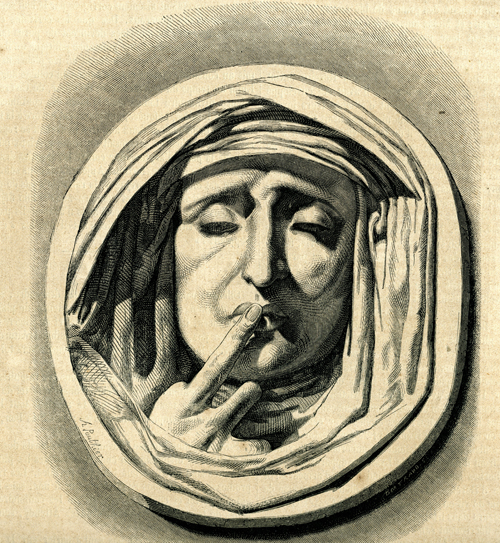
Nothing should remain unspoken long enough to resist interpretation, and nothing should be spoken long enough to not require interpretation. A ground reality, therefore, is that absences are as important as presences; in this case, ‘the absence of silence’ in life takes one very far. Nabokov’s Lolita comes forth here with a very visible paradox of how excess articulation can resemble depth, all while quietly replacing it. When Humbert Humbert begins his confession in the story, he does so with acute fluency as he talks about something morally fractured. He translates his entire inner world into a perverted narrative where nothing remains unprocessed or unexposed.
This is where the philosophical dilemma begins.
Not everything that can be expressed has been fully thought, and not everything worth thinking survives immediate exposure, contrary to what we are encouraged to do in terms of expressing oneself. Expression does not equate to identity, and it surely is not tantamount to personality. The internal life is not simply a repository of private thoughts but a developmental space. In actuality, a developing sense is discreetly harmful. It can be polluted, manipulated or filled to the brim, leaving no room for another. If this space collapses into constant externalisation, thinking begins to adapt to visibility, and truth becomes a long-lost concept.
In a striking contradiction, in Alipur ka Aili, Mumtaz Mufti depicts his crowded inner life that is restless and distorted. But he remains a thinker; thinking almost plagues his reality, but the recognition that not all thoughts are meant to become public truth saves his interiority. This stands in contrast to a contemporary impulse regarding the assumption that inner life gains legitimacy only when externalised. However, some forms of thought lose their integrity the moment they are fully articulated. What Mufti preserves is the discomfort of remaining layered and warped. Which leads the reader to a paradox: the more intensely a person’s inner world is active, the less it may resemble something that can be safely externalised without distortion. So, relatively, Mufti’s writing shows that the self is not always a coherent narrative that is waiting to be told; rather, it can be a plethora of impulses that resist simplification or overgeneralisation.
Oversharing strikes as a tragedy on real emotions that should be felt with sympathy. When we take it upon ourselves to talk about every personal detail, it becomes a performative necessity. You shape your ideas around aesthetics rather than purpose, and it feels more like a rehearsal or an act. From a deeper, psychological perspective, research in Current Opinion in Psychology shows that sharing personal experiences not only produces social outcomes but also intrapersonal consequences, directly altering how individuals process their emotions and beliefs. Let’s say you overshare at work. Does it end there? Never. You gradually become an example that your colleagues give from time to time when a similar topic pops up. The predicament is not expression but how one externalises everything prematurely. This creates a cognitive shortcut which leads to stabilising thoughts too early, even before they have fully evolved. In this perspective, science also subtly supports a philosophical claim that constant articulation can interrupt the natural process of thought maturation.
Ideas should not become identity, an outcome which expression often creates. It makes one predictable, easier to read and accessible to a point of insult. A meaningful internal life requires protection from the impulse to make everything known to people, which is not crucial in any instance. Contrarily, the idea that sharing helps to disengage from atrocious realities is fundamental, but privacy itself should not be seen as withdrawal. It may seem counterintuitive; however, the broader issue is that depth becomes lost. A similar pattern can be observed in highly public personal crises. When grief, for instance, is instantly shared and publicly processed, it quickly falls into the crevices of suggestive external response. It comes forward in the form of sympathy, advice or even interpretation, which makes a person feel disoriented from their own issue. The solution is not simply to establish secrecy but to realise the need for privacy of thoughts out of necessity.
Consider a different kind of case. In recent years, therapists have noted a distinct pattern among individuals who document their lives constantly online, ranging from emotional updates to confessions and conflicts. Initially, it does feel safer and amounts to clarity. However, over time, something shifts. The person starts to experience emotions through their expression of them, as emotions become captions and phrases. It is because of the need to make it all instantly communicable. Therefore, to resist this intrusion, we need non-disclosure agreements with ourselves first, practising concealment and discretion with our own thoughts, avoiding revealing them before we fully process them ourselves.