




In Punjab, traces of Kashmir can be found blended in everyday life. Its influence can be found in the famous Kashmiri pink chai, a pattern stitched into fabric or in calligraphic works on display. All of these crafts, cuisines and pieces of craftsmanship arrived decades ago from Kashmir and blended into local life.
Nowadays, we often hear the phrase ‘Kashmiriyat.’ Given the political circumstances, it is weaponised and has lost its meaning. However, it originally refers to a way of life: harmony, synchronicity, and joint celebration. It refers to the life which has developed in the valley over the centuries. It is a fusion of Hindu, Buddhist, Islamic, and Central Asian influences, fostering a sense of unity and a spirit of co-existence.
After the partition, Kashmiri families started to migrate to central Punjab. Settling in Sialkot and Gujranwala, they brought culture with them. Many pieces, recipes and crafts that were born in the valley came to central Punjab and flourished here.
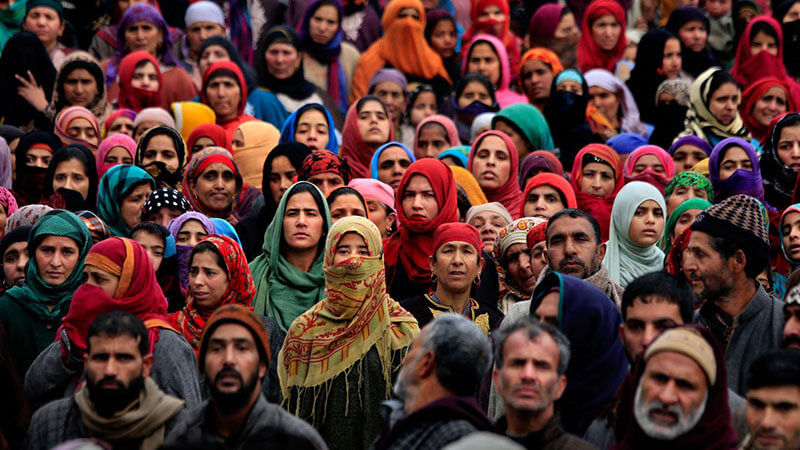
Kashmiris migrated during partition and during conflict periods. The estimated refugee influx of migration of Kashmiris was more than 300,000. Mass migration from areas of Jammu and Kashmir to Central Punjab: Kashmiris arrived and settled in Sialkot, Jhelum and Gujarat. The migration was not voluntary but a means to escape the conflict and to ensure survival. These families (Kashmiri ancestors) were forced to take refuge, and with them, their culture was safeguarded. Culture was preserved because it travelled with those who left.
Kashmiris brought various crafts with them: embroidery, silk production, painting, and textile work. They possessed exceptional knowledge that greatly benefited the economy of Punjab.
Cities like Sialkot and Gujranwala blended crafts into daily life and made them a part of local production. Language also became broken and esoteric. Terms like ‘Kohsur’, which translates to the Kashmiri language, became isolated to inner circles, which never made it to the realm of the public.
Kashmiri ancestry has shifted over time. For the first generation of migrants, identity was lived; it was rooted in places, values, languages and cuisines. To the second generation, practices were passed down, but with less caution and continuity. Culture was reduced to a routine. By the third generation, the connection ceased to be only symbolic. To say “we are Kashmiri” is not a first-hand experience. Rather, a statement of inherited experiences and identity. Detached from places and devoid of context, Kashmiri identity is reduced to memories without experiences.
The history of Kashmir is marked by a long-standing conflict between India and Pakistan over Kashmir. Kashmir is very noticeable in political discussions every day, but it fades away in everyday life and its familiarity. People of Kashmiri origin in Punjab: politically, they are Pakistani Punjabis, but they are culturally more layered. This contrast reveals a reality: Kashmir is loud in political discourse but quiet in everyday life.
Kashmiri traditions have now become absorbed in Punjabi society; their origins are now blurry. Practises that once were limited to specific geographical locations have now become normalised and part of everyday life. Culture has evolved; it’s an identity without geography. It exists in an adapted form, yet it continues to thrive and shape everyday life.
Within families, culture continues to thrive in a quieter and more common way. Elderly women preserve recipes, remedies and tales; they act as custodians of ancestry. These traditions never get entered into a formal record, yet they get preserved in memory for years to come. At the same time, many of these practices don’t get recognised as distinctly Kashmiri. They become absorbed into Punjab’s identity and traditions.
If there is a single Kashmiri fragment running through the streets of Punjab, it is cultural memory that outlived political restrictions. Kashmiri culture was reshaped after migration, through time and distance, but it still lives on. The legacy of Kashmir is persistent and ingrained in our daily lives.