





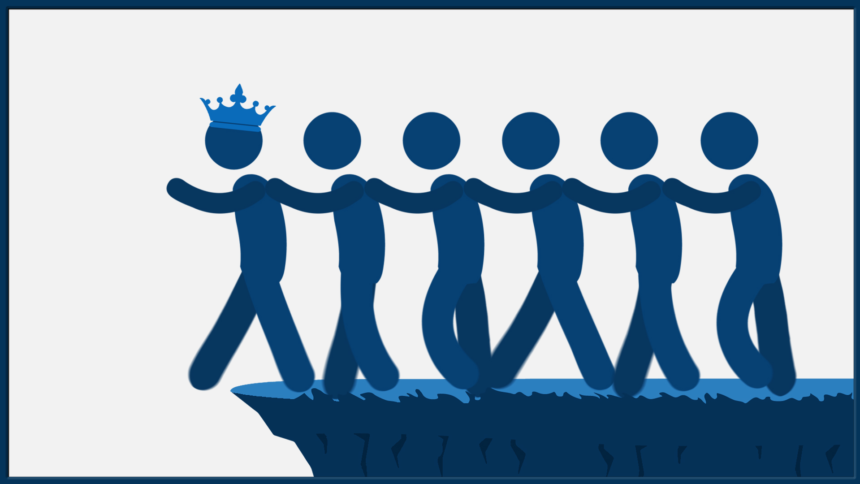
When we’re told that someone is “obedient,” we quickly picture that person as “nice” and “kind” — someone who’d do all that he’s told to do so. Obedience itself is very necessary — way more than a moral responsibility. At its best, it maintains the system. Imagine a world where people didn’t obey the rules or didn’t respect the authority — it would cause the whole system to collapse.
Obedience as a Curse
As Einstein once said, “Unthinking respect for authority is the greatest enemy of truth.”
The moment we start acting like puppets and stop questioning the rules, obedience becomes a curse. If we look back in time, there were various rules that served injustice, but no one ever questioned them… why? Because disobedience was not even an option. Even now, if you question authority, you’re the villain.
Disobedience as a Virtue
“One has a moral responsibility to disobey unjust laws.” These words by Martin Luther King Jr highlight a prime responsibility of those with conscience to disobey when obedience starts feeling like a crime.
Under the oppressive system of apartheid, Nelson Mandela refused to obey laws that enforced racial segregation and inequality. Choosing resistance over compliance, he actively opposed a system designed to strip basic human rights. For this defiance, he was imprisoned for 27 years — an immense personal cost for standing by his principles.
Similarly, when girls in Pakistan’s Swat Valley were forbidden from going to school, Malala Yousafzai refused to accept silence as obedience. She spoke out for her right to education, directly challenging the authority imposed by militants. In 2012, she was attacked for her defiance — a consequence meant to suppress her voice. Instead, it amplified it. Her story reveals a harsh truth: standing against injustice often comes at a cost, but it is precisely this courage to disobey that can inspire lasting change.
Alongside these, you’ll find thousands of cases when people questioned authority and faced consequences.
Obedience as Greatness
Someone who follows the rules without asking ‘why’ leads a peaceful life — addressing ignorance as a ‘bliss,’ as it’s less risky. The person who fits into this criteria gets respect in the eyes of everyone, but deep down, he knows he sacrificed his own self-respect for this act. Paradoxically, over time, after repeating the same action twice or thrice, he gets used to it and stops feeling guilty.
Supposedly, if someone chooses to speak up, the controversies around him make him feel bad for being such an ‘ungrateful’ person that he eventually stops questioning and becomes a part of the unconscious.
When Obedience Starts To Take Over
We’re always — unquestionably — being obedient. Following the teachers, parents, leaders and everyone else. We’ve been taught obedience since childhood, so it has been so normalised that we don’t question it anymore. It’s not that the idea of the rule showing injustice doesn’t come to our mind; it’s just that the moment it comes to our mind, our brain suppresses it with the idea, “What difference will it make?” If you ask a child to stop doing something, he’ll ask, “Why?” to it. Henceforth, the inner child in us knows that there’s no answer to certain questions, so why would we sacrifice our peace for it?
When Obedience Starts Taking Your Rights
At the peak of unquestioned obedience, driven by the so-called ‘moral responsibility,’ you begin to lose your rights. This all starts when we say yes to our parents, friends, or co-workers because we don’t want to be seen as “rude.” Just because we’re unable to be disobedient to certain injustices, we start losing our valuable time, efforts and energy. Tragically, we all have to stay in this system unless we make changes to our backward mindsets.
If history has taught us anything, it is this: Obedience maintains order — but it is disobedience, at times, that creates justice. Perhaps the real question is not whether we should obey, but whether we are willing to take responsibility for the consequences of our obedience. Because in the end, silence and compliance are choices too.