





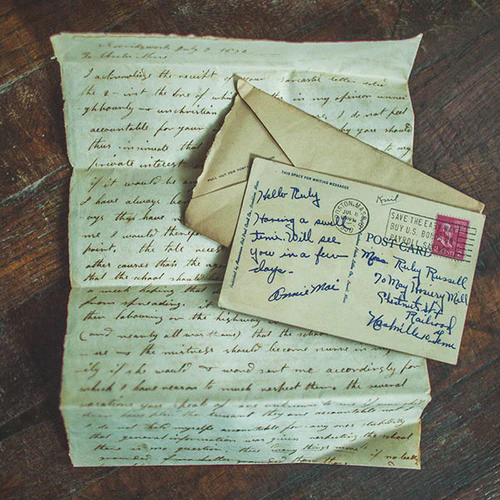
Exchanging handwritten cards always meant a lot to me, ever since I was a child. Eid, birthdays, anniversaries, to me all these occasions felt incomplete without them. The careful selection of paper, a meaningful message, the excitement of opening an envelope addressed to you. It is a simple act, yet it holds such intimacy that no personalized GIF or text message can replace it. Holding a card, knowing that someone took their time out and sat down in such a busy world, adds to the emotional value of it.
Handwritten letters hold deep cultural importance across South Asia; they were a means of communication. People kept in touch with their extended families and friends through letters long before calls and text messages existed. Letters carried great emotional value, affection and longing. Important messages and invitations for Eid, birthdays, or other occasions were shared through letters. Letters connected people in both moments of bliss and times of hardship.
Entire systems centred around postcards and postal services, providing job opportunities to individuals and maintaining communication. There is also a clear social hierarchy here: one person wrote the letter, a postman delivered it, and someone else got to read it. Here each role, each designation represented a social class, from government and elites to the working class.
Letters can be considered as memento, preserving emotions and moments in time. They often become part of a memory box, and serve as a reminder of people, places and emotions. Carefully collected and stored in boxes, letters take us back in time. They allow us to revisit our deepest memories and hold onto them.
South Asia has a complex history, marked by tensions, conflicts and colonial legacy. Due to the large influx of migrants, letters were an imperative means of communication — families connected over physical and emotional distances. In times of doom and despair, letters brought safety and reassurance.
In colonial and post-colonial times, letters were a quiet form of resistance. They were political tools used for protests, movements and petitions. Revolutionists used to run movements in disguise, questioned the control, drafted petitions, and documented injustice. Even when freedom of speech felt optional, the voices found their way onto paper. In this way, letters became a subtle but powerful tool to push back against control. It also has a deep connection with bureaucracy
and the state. In earlier times, communication with the state heavily relied on letters.
In earlier times, education wasn’t easily accessible. Those who were literate held power over the illiterate folks. Often the voices of the uneducated were expressed through the educated. Due to many circumstances like gender, race and class, people often lacked functional literacy. Letters allowed them to co-exist with society, creating a safe space. On the other hand it was also an access to power. Governments, elites, and educated classes dominated written communication.
At the same time, letter writing reflected a class division. Letter writing demonstrated a clear reality of the society. Education was accessible to those backed up by social and economic status. Other people usually relied on the channels to express their thoughts. This often led to the loss of emotions and information as the letters were usually watered down, causing inequality. This caused a loss of control on one’s own expression.
Social media has greatly replaced the art of letter writing. What was once written with great care and thoughts can now be typed in seconds. Letters are now replaced by texts and calls, quick and fleeting. Slow and thoughtful moments of communication now feel hurried and instant.
Handwritten letters are also a measure for love and effort. Taking time out of a day, sitting down and writing your emotions on a paper. Going through the laborious task of getting it posted, and then waiting for a reply. Compared to a text that takes seconds, letter writing requires time. Social media has also given a rise to the death of anticipation. Waiting for a letter makes one go through many stages like excitement, hope, fear and anxiety. We just didn’t lose letter writing, we became prone to urgency.
Handwritten letters were primarily a form of communication but they also were a sign of effort, emotion, and affection. As they fade away with time, we also lose our cultural identity. In replacing letters with messages, we have unknowingly lost depth and the sincerity that kept us connected.
The part where the author talks about how letters reflect on a social hierarchy is such a novel idea!