





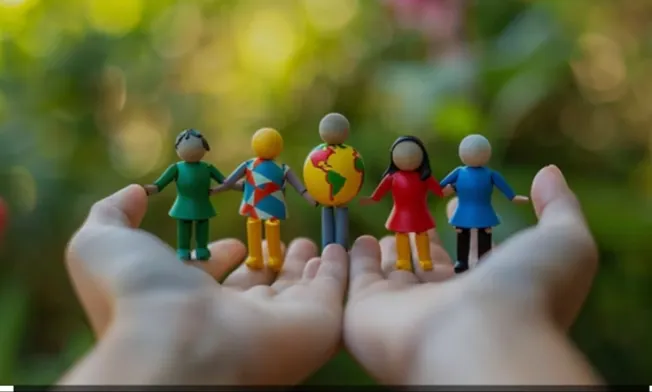
‘Family’ and ‘culture’ are two words that we have heard since our childhood. It may seem these are two simple words in the English dictionary, but they hold significant importance in our daily lives. If someone asks you a question, “What is family?” there will be different responses; some might say parents and siblings, some might say my husband or wife and our kids, some might say parents, siblings, grandparents, uncles, aunts and cousins, and some might even say friends are family, etc. Do we realise this? Whatever the answer is, it’s influenced by our culture. Family and culture may seem like two different things, terms, or words, but they are intertwined with each other.
Culture is the shared beliefs, values, traditions, customs and behaviour of a group of people. It is influenced by religion, traditions, language, social norms, gender expectations, parenting styles, ideas about marriage and respect. Culture acts like a guidebook that tells people how to behave, what is acceptable, and what roles family members should have.
Family is one of the most important social institutions. Most of the world’s population lives in family units, making families an important primary group in society. It plays a vital role in the socialisation of individuals; families are regarded as the first society of human beings. George Peter Murdock defined family as a universal social institution consisting of adults of both sexes and their children who live together, reproduce, cooperate economically, and socialise with the young.
In older times, most cultures were based on survival and cooperation. Joint or extended families were very common. Many generations lived together in the same household for years and years; there was no concept of moving out. Roles were divided gender-wise; men were the breadwinners and women were homemakers, with elders having the authority in making decisions. This system existed, as there were no social security systems; families supported each other. Cultural traditions emphasised unity and obedience.
When societies moved from farming to industrial jobs, cultural values began shifting toward independence, moving to cities, and smaller households. Family systems changed; nuclear families became more common as young adults moved away from parents for jobs. Economic dependence on extended families decreased; this was one of the biggest turning points in family evolution.
As education increased, culture started valuing personal achievements, career development and individual identity. The family system changed a lot due to this, as women entered education and the workforce, marriage became more about companionship, parenting became more emotionally focused, and decision-making became more equal.
In modern times, societies are greatly influenced by global communication and technology. This influence greatly impacted the cultural changes, including exposure to different lifestyles, changing gender roles, greater acceptance of different family structures, and delayed marriage and parenthood. These resulted in variation in families, to name a few, single-parent families, blended families, long-distance families and dual-income households.
Today many societies have a mix of traditional and modern values. For example, respect for elders still exists, family bonds remain strong, but individual choices are increasing. For example, in many South Asian societies, joint families were common in the past. Urbanisation created more nuclear families, but emotional and financial connections with extended families remain strong. This shows evolution, not loss.
Over time, culture and family systems have changed from being strict and focused on survival to being more flexible and emotional. With these changes, the main purpose of family. To support each other feels like we belong and have an identity. It is still important across cultures.