





At a recent panel during the Lahore Literary Festival with the Director General of the Walled City Lahore Authority, Lahore — once again — was described as a palimpsest: a manuscript written in Hindu, Sikh, Muslim, and British hands.
Having spent three formative years in Lahore as a wanderer and an admirer, I dissent, not from the metaphor per se, but perhaps from its sentimental misuse, and yet, as anyone who has traced a fingernail along the scars of a scraped wall knows, a palimpsest is not simply a bouquet of layers.
A palimpsest is intrinsically a site of abrasion. The very etymology is surgical in its brutality: ‘palin’ (again) + ‘psao’ (to scrape). Hence, what survives does so through chemical stubbornness and accident, and perhaps the bias of the scraper, which can lead to the preservation of certain texts or images while others are lost entirely. To call Lahore a palimpsest is to acknowledge that erasure has been a structural feature of its history. The problem is not the metaphor. The problem is that we use it without acknowledging the scraping, which refers to the historical layers and complexities that have been overlooked in the process of restoration and interpretation.
Under its current leadership, the WCLA has undertaken energetic restorations. I had the pleasure of observing three of the most enthusiastic restorations.
Near New Anarkali, traffic coagulates around the renewed sheen of Neela Gumbad. Under the auspices of the Lahore Authority for Heritage Revival, particulate accretions are being removed through calibrated cleaning, compromised faience tiles are being replaced with historically matched glazes, and the intrusive commercial growth is being removed to restore the monument’s architectural clarity.
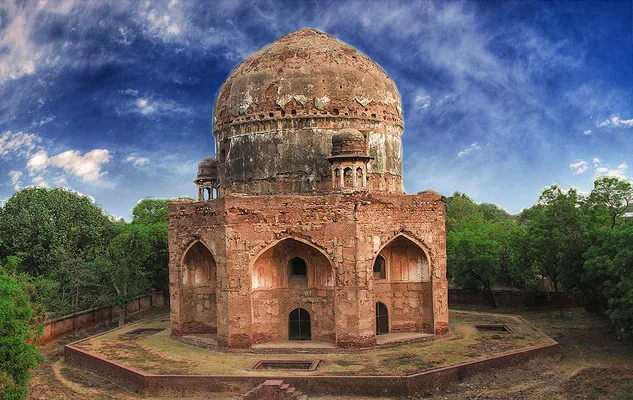
Similarly, the Tomb of Ali Mardan Khan, situated near Lahore Railway Station — the seventeenth-century engineer associated with the canal system that supplied the Shalimar Gardens — has seen masonry consolidation and rearticulation of the octagonal structure through structural stabilisation and surface repair.
Likewise, a year of conservation work spanning around 2017-2018 at Dai Anga’s Tomb, at Gulabi Bagh, associated with Shah Jahan’s court, involved desalination of brick masonry, reapplication of lime plaster compatible with original materials, and the preservation of surviving kashi-kari panels.
Across these projects, one cannot help but observe a constant pattern that Mughal-era Islamic monuments receive methodical conservation grounded in technical protocols, material analysis, controlled cleaning and historically appropriate mortar work, thereby reinforcing their visibility within the city’s officially curated heritage landscape.
A short distance from the grave of Qutb-ud-Din Aibak stands a Hindu mandir. Its shikhara rises in a curving vertical thrust toward a weathered amalaka. Vegetation threads through its parapets. The plaster has fissured. It is in a bittersweet state of withering.
After dusk, Aibak’s tomb closes at regulated hours. The temple does not. It is tended by a woman with a broom. After Partition, she tells me, temples were abandoned, and migrating families like hers settled within their precincts. She has lived beside this structure for decades.
Here, the metaphor of the palimpsest falters.
If Lahore is layered, then the layers are not treated equally. Some are consolidated with lime mortar and chemical precision. Others are left to wither.
The adjacency of Aibak’s tomb and the mandir is not accidental. One marks the institutionalisation of Muslim sovereignty in North India. The other bears witness to what preceded it. To restore one while allowing the other to deteriorate is not necessarily malicious — but it is consequential. It determines which past appears sovereign and which appears residual.
A genuine palimpsest would demand attention to all inscriptions, not only those aligned with contemporary identity.
The question is not whether Mughal monuments deserve conservation. They do. The question is why material equity across religious and temporal differences remains absent from heritage policy.
Lahore does not become plural or a palimpsest because we describe it as such. It becomes plural when preservation is not contingent upon theological lineage, when domes and shikharas gleam alike.
Well written👌
Such a good take 🙌
My viewpoint is consistent with both assessments.On the one hand, Lahore is described as a palimpsest, whereby it has structural flaws that preserve our artifacts, monuments, and statues etc. Verily, it is partially accurate. This is because of the variety of rulers who ruled over the subcontinent. Additionally, they were bearing opposing, rival thoughts against each other. In practice, they had a great political clout over the subcontinent. Consequently, these artifacts were doomed to repercussions. On the other hand, sentimental misuse in the case of endangerment of temples is playing a pivotal role in giving air to the flames of India-Pakistan strained relations. However, this is also partially accurate. By dint of our political authorities, lacking religious affiliations, one cannot blame solely the religion. Despite this, these authorities do so to escalate tensions to detract attention of the people from acute issues. Contrarily, my opinion transcends the dreary realities of structural flaws and the heart-wrenching realms of sentimental misuse. In addition to this, the endurance of achievements (of anyone) is primarily characterized by their consequences. Achievements are pre-dominantly predicated on their eternal features. Achievements of a person need no symbol, artifact, vestige, monuments or statues etc. English men bestowed institutions like GCU and infrastructure like many bridges and roads upon us, which have not been deteriorated or damaged yet. Eventually, when people themselves establish their statues as a result of taken perks from their achievements, then there is no need to preserve them. Achievement itself will preserve the relic.
My viewpoint is consistent with both assessments.On the one hand, Lahore is described as palimpsest, whereby it has structural flaws to preserve our artifacts, monuments and statues etc. Verily, it is partially accurate. This is because of a variety of rulers, who have ruled over the subcontinent. Additionally, they were bearing opposing rival ideologies against each other. In practice, they had a great political clout over the subcontinent. Consequently, these artifacts doomed to repercussions. On the other hand, sentimental misuse in case of endagerment of temples is playing a pivotal role in giving air to the flames of india pakistan strained relations. However, it is also partially accurate. By dint of our political authorities , lacking the religious affiliations, one cannot blame solely the religion. Despite this, these authorities do so to escalate tensions to detract the people from the acute issues . In the third place, people themselves engage in such activities. Contrarily, my opinion transcends the dreary realities of structural flaws and heart wrenching realms of sentimental misuse. In addition to this, the endurance of achievements by anyone are primarily characterized by their consequences. Achievements are mainly predicated on their eternal features. Achievements of a person need no symbol, artefact , vestigue, monument and statues etc. The British established institutions such as GCU and infrastructure including bridges and roads, which remain enduring. Furthemore, when people erect statues to commemorate individuals from whom they have derived benefits, these structures are resilient to deterioration.