





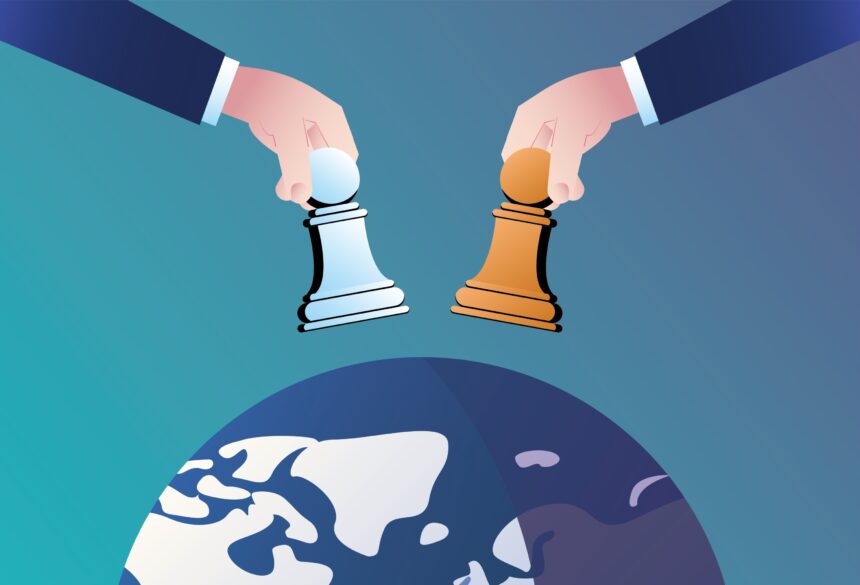
The global power struggle unrolling today is less about oil and more about declining power. As the unipolar world is shifting to a multipolar world, the US views the changing environment as a threat to its long-established hegemony, posing a serious challenge.
In terms of international relations, Washington appears trapped in what scholars call the Thucydidean Trap — a dominant power trying to snub the emerging powers to preserve its leadership. This phenomenon explains why US actions abroad, especially in Latin American countries, are not solely for the oil but extend far beyond.
Venezuela’s vast oil reserves have immense strategic significance, but focusing only on energy concerns would be misleading. The central objective of this is to curb China’s influence in Latin America, which is actually the backyard of the USA. Recently, China has become the largest importer of Venezuelan oil, prompting Washington to spare no effort in limiting Beijing’s access as a rising competitor. China’s economic engagement in the region has grown rapidly over the past decade. Before President Maduro’s capture, China had forged around six hundred agreements with him. Such engagements are a matter of concern for the US and intensify the decline of its global hegemony.
Furthermore, the US is curbing China’s influence in the Western Hemisphere to prevent China from becoming an alternative to the US in regional trade, and virtually no country tolerates rivals in its strategic backyard. Similarly, Russia doesn’t accept Ukraine joining NATO, and China never accepts any challenge to its claim concerning Taiwan.
Beyond that, China and Russia pose an even greater threat, not merely due to the ideological differences but because of their growing influence in the Global South. Intergovernmental platforms, like BRICS and the Shanghai Cooperation Organisation (SCO), are increasingly signalling a new multipolar global order. As of 2021, the SCO is the world’s largest regional organisation, encompassing 40% of the world’s population and 20% of global GDP. Indeed, even one of the EU’s top diplomats, Kaja Kalas, said in April this year, quote unquote, “The international order is undergoing changes of magnitude not seen since 1945.”
The United States, however, seems unwilling to accept it. Consequently, it is expending a lot of military and political efforts around the world, countering its rivals, and preserving the status quo. Historically, dominant powers never relinquish power peacefully, and politics often behaves like inertia — resisting change even when it becomes inevitable.
Trump’s signature slogan, ‘Make America Great Again’, itself acknowledges a perceived decline. This implicit recognition entails not only weakening the United States but also a wider deterioration of the Western liberal order. Ironically, Trump, who entered office pledging an end to wars, is now set to launch wars.
US foreign policy towards China, Russia, and now India is vividly confrontational. For instance, from kidnapping Maduro to threatening Greenland, Colombia, Cuba, Mexico, and Iran, it is asserting itself as the only hegemon of the world. In addition, via deliberate provocation, the US aims to assess China’s ability to exercise restraint.
Perhaps the greatest irony is that the very architects of the United Nations-led liberal order now appear among its most active disruptors. As power diffuses globally, the struggle is less about controlling resources and more about preserving relevance in a rapidly changing global landscape. The question arises: will this shift in global order occur without a third world war?
Nicely explained