




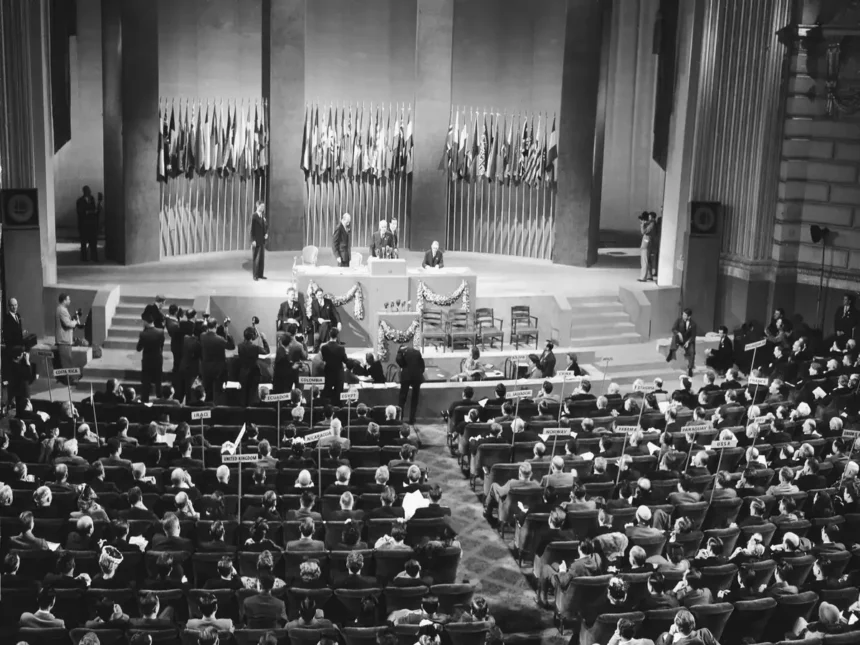
The United Nations was not created to take mankind to heaven but to save humanity from hell. (former UN Secretary General Dag Hammarskold). The United Nations was created in 1945 after the failure of the League of Nations and the outbreak of a devastating Second World War. The main purpose of the formation was to maintain peace and security, promote development, and uphold human rights. It has six basic organs, which perform their specific functions related to security, administration and justice.
Emerging from the ruins of the Second World War, the institution promised not merely diplomacy but the prevention of another global catastrophe through cooperation, international law, and multilateral accountability. Eighty years later, however, the organisation exists in a geopolitical environment increasingly defined by paralysis rather than prevention. From Gaza and Ukraine to Sudan and Myanmar, the United Nations has watched prolonged humanitarian crises unfold in real time while remaining structurally incapable of decisive intervention. The United Nations was formed to maintain peace, but despite its existence, the world’s contemporary situation is heart-wrenching.
The failure is not totally operational, but it is more due to structural discrimination. The Security Council, once formed as the stabilising centre of the post-war order, has instead become a theatre of strategic deadlock. It has 15 members (five permanent and 10 non-permanent members). Each member has one vote, but the five permanent members have the power to veto any decision apart from those on procedural issues. But the veto granted has transformed the Council from an instrument of collective responsibility into a mechanism vulnerable to geopolitical obstruction. Russia vetoing Ukraine-related resolutions and the US vetoing Gaza ceasefire resolutions shows their strategic interests. In principle, the UN claims universality. In practice, enforcement often reflects hierarchy.
The contradictions of the United Nations are most visible in cases of humanitarian intervention and genocide prevention. After failing to prevent atrocities in Rwanda and Bosnia, the UN adopted the Responsibility to Protect doctrine, promising stronger international action against mass violence. Yet recent conflicts continue to show how selectively these principles are applied, often shaped more by political interests than by consistent legal standards. This selective enforcement has weakened the organisation’s credibility.
At the same time, the UN remains central to global governance. Agencies such as the World Food Programme, UNICEF, and the UNHCR continue to provide humanitarian aid, refugee assistance, healthcare support, and peacekeeping operations worldwide. Despite frequent criticism, states still rely heavily on the UN during crises.
The question, therefore, is not whether the United Nations has completely failed, but whether the expectations placed upon it were ever realistic. Created to prevent another world war rather than eliminate all conflict, the organisation reflects both the possibilities and limitations of international cooperation. At eighty, the UN remains constrained by power politics, yet no alternative global institution has emerged to replace it.
Very informative this article help me to understand many things easily