





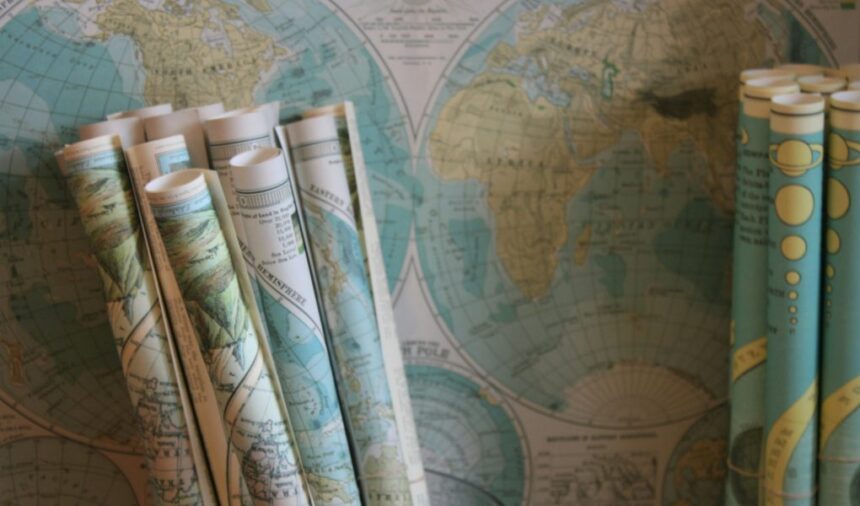
In modern societies, the nature of maps is evident. Most people in the 21st century do not use maps daily, but they know what to expect of a map: it is free of error, objective, and simply a representation of the area or the network of roads. They do not think about where maps come from, and their objectivity is only questioned when the content of the map is significantly different from their own experience. Maps are assumed to be statements of geographical reality produced by unbiased and objective cartographers, blind to the idea that the cartographer is not an ‘acentric’ being. Rather, various cartographers impose various perspectives upon the peruser.
The postmodern era demands that we do away with this empiricist reading of a map by breaking the shell of objectivity with which we have covered the map in order to expose it for what it is: a document rooted in historical and cultural context.
Brian Harley, a British cartographer and map historian, was the first person to examine a map as an ideological tool, which he found to be particularly potent because it masquerades as a seemingly irrefutable piece of topological information. He insisted that beneath this facade lies an elaborate rhetoric of power, entrenched in political and social interests (those of rulers, colonisers, administrators and landowners).
Historical evidence repeatedly shows that maps have rarely been neutral artefacts. A most controversial map is the Mercator projection, which dramatically enlarges the continents of Europe and America while making Africa and South Asia appear significantly smaller. A projection that was so widely distributed that it is still displayed in classrooms around the world.
Colonial cartography also operated through omission. In early European maps of the Americas, entire indigenous communities were gradually erased from the landscape. Spaces occupied for centuries were depicted as empty expanses being ‘discovered’ for the first time.
In the 20th century, totalitarian regimes employed the persuasive power of cartography. In the decades preceding the Second World War, Nazi maps highlighted the distribution of ethnic Germans beyond Germany’s borders. Thus, by framing different regions as culturally German, they transformed an act of barbaric invasion into a completely logical act of reunification.
The political machinations involved in cartography did not disappear with the end of colonial empires. In fact, some of the most contested cartographic representations today arise from unresolved territorial disputes. For example, the contested region of Kashmir. Maps drawn by the two countries portray the region differently; Indian maps depict the entire region as vital Indian territory, while Pakistani maps show it as disputed along the Line of Control. These are not mere geographic disputes but political and ideological assertions embedded in maps.
Hence it is proven that what appears to be an accurate, error-free depiction of geography is often a carefully constructed portrayal shaped by ideology, power and political ambitions. To read a map critically, therefore, is to understand that these are not mere symbols, but rather historical, political, and profoundly cultural.