





Artificial intelligence (AI) refers to computers having the capability to implement tasks that once required human intellect, such as predictions, analyses, and recommendations. AI’s current progress seems to challenge human intellect. Business, medicine, software, and engineering are already implementing AI.
The question arises: what are the ethical risks of using something that seems too good to be true?
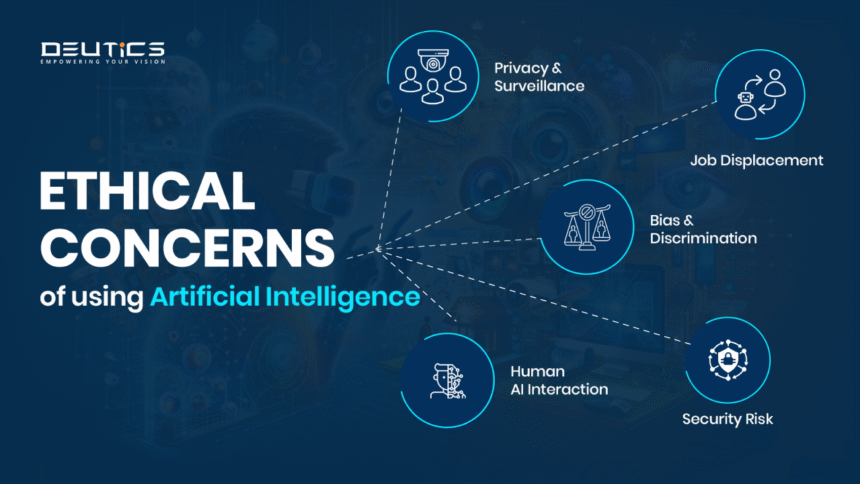
Researchers have found that AI contributes to climate change, misinformation, privacy risks, and unemployment. Yet we benefit from its accuracy and efficiency.
AI is emerging worldwide as a replacement for human labour. Factors such as accessibility, low cost, reduced errors, and accuracy make it a better option in the market. AI has replaced basic jobs like checkout systems at many outlets. For example, Walmart and Target use AI to prevent theft, report suspicious transactions, and analyse shopping trends. (The Editors of ProCon, 2025)
“Zero-click reality” refers to finding answers from AI overviews instead of getting them from original sources. By late 2024, ChatGPT had acquired approximately 15 million users, reducing web traffic by 15–20%. This phenomenon causes losses for many hard-working publishers and writers, leaving their content to be trained by AI models without receiving credit.
AI also significantly harms our environment. Data centres have consumed six times more water than the entire population of Denmark (6 million estimated), according to the United Nations Environment Programme, 2024.
Let’s look at the statistics of one of the most popular AI chatbots, ChatGPT. It is estimated to receive a billion queries per day, using 85,000 gallons of water. The energy the GPT-4 model uses to write a 100-word email is equal to charging 7 iPhones.
AI has its privacy risks, including deepfake technology. Data privacy is defined as one’s right over their personal data. AI privacy risks include collection, leakage and usage of data without consent. AI models are trained with data; the data can range from biometric to financial information. On March 20th, 2023, ChatGPT developed a bug allowing users to view other people’s chat history, which was later fixed. But how many more bugs will appear in the future?
Let’s move on to deepfakes, which utilise artificial intelligence to substitute a face or body in pre-existing footage. Deepfakes are typically used for scams. They can target minors online who lack digital protection. In 2017, Noelle Martin discovered deepfake pornographic videos of her distributed among many porn sites. These deepfakes were created from pictures of her on social media. She described this fraudulent video as having a deep-rooted impact on her relationships, employability and reputation.
In conclusion, AI poses numerous risks that we often overlook or disregard as inconsequential. This is a disease that is now beginning to show its symptoms. If the world does not take action, this disease will eventually reach a point where its effects will be irreversible. AI may seem to make our lives easier, but everything has a consequence.
Right! Everything has consequences!