





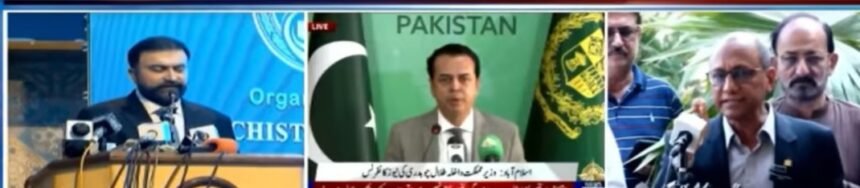
Minister of State for Interior Talal Chaudhry on Wednesday strongly criticised Pakistan Peoples Party (PPP) Chairman Bilawal Bhutto Zardari over his recent remarks on democracy, constitutional matters and the proposed creation of new administrative units, accusing the party of failing to translate its democratic claims into effective governance.
Responding to Bilawal’s statements, Chaudhry said the PPP chairman had delivered a forceful political speech but questioned his party’s record on governance and public service delivery.
He said Bilawal frequently portrayed himself as a defender of democracy and the Constitution while highlighting constitutional achievements associated with his party and family. However, he argued that advocating democratic principles was different from implementing them in practice.
The minister claimed that the PPP held influential positions across the country’s political system, including participation in provincial governments and control of the offices of president and Senate chairman.
Despite this political influence, he said, Bilawal continued to speak as though he were an opposition leader.
Chaudhry claimed that the PPP exercised influence over approximately 70% of the country’s governance structure and questioned why it was opposing proposals for new administrative units.
Referring to the party’s 17-year rule in Sindh, he accused the provincial government of failing to adequately address public problems despite having access to substantial resources.
The minister maintained that proposals for administrative restructuring were intended to improve governance and public service delivery rather than divide provinces along linguistic lines.
He argued that areas struggling with inadequate healthcare, education and other essential services required more effective administrative arrangements.
Chaudhry also questioned what he described as inconsistencies in the PPP’s constitutional position, saying the party celebrated its role in framing the 1973 Constitution and introducing the 18th Amendment while resisting discussions about further administrative reforms.
Responding to Bilawal’s warning about the possible use of “brute force” to divide Sindh, the minister said constitutional and political disagreements should be settled through democratic procedures.
“Bilawal has always maintained that decisions should be made through the ballot, not the bullet,” Chaudhry said, urging political leaders to avoid rhetoric that could increase tensions.
He questioned whether decisions reached through voting should be portrayed as potentially leading to bloodshed.
The minister stressed that democracy required more than political speeches and constitutional interpretations, arguing that effective governance, institutional performance and public welfare were equally important.
He also referred to Bilawal’s earlier parliamentary remarks supporting the establishment of constitutional courts, which the PPP chairman had reportedly linked to the vision of Quaid-e-Azam Muhammad Ali Jinnah and his late mother, former prime minister Benazir Bhutto.
Turning to Bilawal’s comments concerning Jamiat Ulema-e-Islam-Fazl (JUI-F) chief Maulana Fazlur Rehman, Chaudhry suggested that the PPP chairman should instead question his own party’s governor in Khyber Pakhtunkhwa.
He alleged that the governor had previously held a press conference criticising Maulana Fazlur Rehman and had repeatedly made statements against him.
Chaudhry maintained that questions concerning the rule of law and the sources of political leaders’ assets were legitimate, regardless of an individual’s religious appearance or public standing.
He argued that seeking accountability should not automatically be interpreted as a personal attack.
Addressing constitutional reform more broadly, the minister said Pakistan’s Constitution had undergone amendments over time to accommodate changing national circumstances and could be amended further when necessary.
He maintained that decisions concerning the country’s administrative structure should reflect governance requirements, constitutional procedures and evolving national needs.