





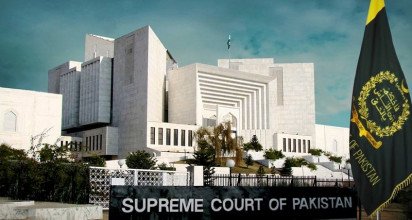
The Supreme Court has ruled that constructing a shrine on privately owned land, burying a family member there and allowing devotees to visit and make offerings do not, by themselves, establish the property as waqf. The court declared the Punjab Auqaf Department’s takeover of such land unlawful.
A two-member bench comprising Justice Shahid Waheed and Justice Naeem Akhtar Afghan dismissed an appeal filed by the Chief Administrator Auqaf Punjab against a Lahore High Court judgment concerning five kanals and three marlas of land in Tawaley Wali, Tehsil Pindi Bhattian, District Hafizabad.
In its 10-page written judgment, authored by Justice Shahid Waheed, the apex court emphasised that the essential requirement for creating waqf was the permanent dedication of property for religious, charitable or other recognised purposes.
The court observed that such dedication could be established through an oral declaration or inferred from the conduct of the property owner. However, there must be clear evidence demonstrating an intention to permanently dedicate the property and relinquish ownership rights.
The judgment clarified that the mere presence of a grave or shrine, even one regularly visited by devotees who offer donations, was insufficient to establish that the landowner had surrendered the property as waqf.
The dispute originated from a property purchased through a registered sale deed in 1988. In 1993, the owner permitted the burial of a family member, Syed Shabir Hussain Shah, on the land and subsequently constructed a shrine over the grave.
The property later became the subject of a dispute involving the Auqaf Department, which assumed control of the land and the structures situated on it.
The Supreme Court upheld the Lahore High Court’s decision against the department, finding that the circumstances surrounding the shrine did not automatically establish a valid dedication of the property as waqf.
The bench directed the Auqaf Department to return the administration, control and possession of the disputed land, together with all existing structures, to the original owner within 30 days of receiving the judgment.
The ruling draws a distinction between the religious use of privately owned property and its formal dedication as waqf, underscoring that public devotional activities alone cannot extinguish an owner’s property rights.
By requiring clear evidence of permanent dedication, the judgment establishes that the legal status of a shrine and its surrounding property must be determined by the owner’s intentions rather than solely by the religious activities conducted there.