





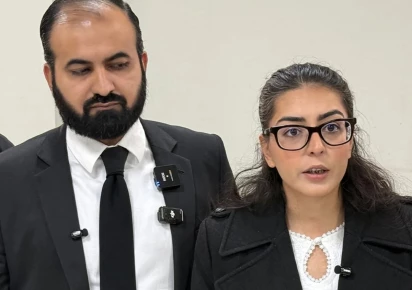
The Supreme Court on Wednesday disposed of appeals filed by human rights lawyers Imaan Mazari and Hadi Ali Chattha challenging proceedings in the barriers removal case, declaring the matter infructuous because their trial had already concluded.
A three-member bench headed by Justice Muhammad Ali Mazhar heard the appeals and observed that the petitioners had already approached the Islamabad High Court (IHC) following their convictions.
The apex court ruled that the high court would determine the maintainability of the pending petitions and appeals.
On Friday, Mazari and Chattha had filed appeals before the IHC challenging their convictions, along with separate applications seeking suspension of their sentences and release on bail pending the outcome of the appeals.
During Wednesday’s hearing, Advocate Faisal Siddiqui, representing the petitioners, informed the Supreme Court that the anti-terrorism court (ATC) had completed the entire trial inside jail within just 22 days.
“The trial has already been completed, and the case has now become infructuous,” Justice Mazhar observed.
Siddiqui expressed concern over delays in the judicial process, arguing that the petitioners had been compelled to approach the Supreme Court merely to secure hearings of their cases before the high court.
“Even if you hang us, at least hear the case,” he told the bench, highlighting what he described as difficulties in obtaining timely judicial consideration.
The lawyer explained that the petitioners had initially approached the IHC to challenge the trial court’s framing of charges and alleged procedural irregularities during the proceedings.
However, the high court did not suspend the trial, prompting the petitioners to seek relief from the Supreme Court.
Siddiqui further complained that the apex court had also failed to schedule the matter for hearing before the trial was completed.
The Supreme Court ultimately disposed of the appeals without ruling on the merits of the petitioners’ objections to the trial proceedings.
The lawyers’ challenges to their convictions and their requests for suspension of sentences and bail remain before the Islamabad High Court, which will determine how to proceed with the pending matters.