





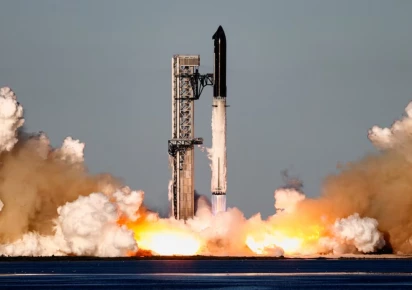
SpaceX launched its Starship spacecraft on its 15th test flight from Texas on Friday, successfully sending the vehicle into orbit as the company pursued a historic attempt to return the spacecraft to its original launch site for the first time.
The mission represents a major test of Elon Musk’s ambition to develop a fully reusable rocket system capable of travelling into orbit and returning to Earth for repeated launches.
Although Starship’s upper stage successfully reached orbit approximately 27 minutes after liftoff, the mission suffered a setback when its Super Heavy booster exploded over the Gulf of Mexico following an apparent deviation from its planned return trajectory.
SpaceX had intended to recover the booster shortly after its separation from the upper-stage spacecraft, using the company’s innovative tower-mounted mechanical arms, commonly known as “chopsticks”, to catch the descending rocket.
However, the booster was diverted from its intended flight path for reasons that were not immediately clear.
Instead of returning to the launch tower, the rocket travelled towards the Gulf of Mexico, where it briefly hovered above the water before exploding a short distance above the sea surface.
The cause of the booster failure was not immediately established, and SpaceX had not provided a detailed explanation of the incident at the time of the initial report.
Despite the loss of the booster, the company continued with the upper-stage portion of the mission, which remained central to its objective of demonstrating a complete orbital round trip.
According to the mission plan, the uncrewed Starship upper stage was expected to spend nearly a day in orbit before beginning its return journey to Earth on Saturday.
The spacecraft would then re-enter the atmosphere and attempt an engine-controlled descent towards the same launch facility in Texas from which it departed.
If successful, the upper stage would be captured by the launch tower’s giant mechanical arms, marking a significant achievement in SpaceX’s efforts to make both stages of the Starship system reusable.
The planned recovery would demonstrate the feasibility of returning an orbital spacecraft directly to its launch infrastructure rather than relying on a conventional landing or ocean splashdown.
SpaceX has been developing the Starship system with the goal of reducing the cost of space transportation by allowing major rocket components to be recovered, refurbished and launched again.
The enormous spacecraft consists of two principal sections: the Super Heavy booster, which provides the thrust required for liftoff, and the Starship upper stage, which is designed to carry payloads and eventually passengers into space.
The company’s recovery strategy involves catching returning rocket stages with mechanical arms attached to the launch tower, eliminating the need for conventional landing legs on the vehicles.
Friday’s flight demonstrated the upper stage’s ability to reach orbit but also highlighted the technical challenges involved in recovering the massive booster.
Mission controllers were continuing to monitor the upper-stage spacecraft as it prepared for its planned return to Earth.
The outcome of Saturday’s anticipated landing attempt will determine whether SpaceX can achieve its goal of completing a full orbital round trip and recovering Starship at its original launch site.
While the booster explosion represented a setback, the successful orbital insertion allowed the company to proceed with the mission’s remaining objectives.