




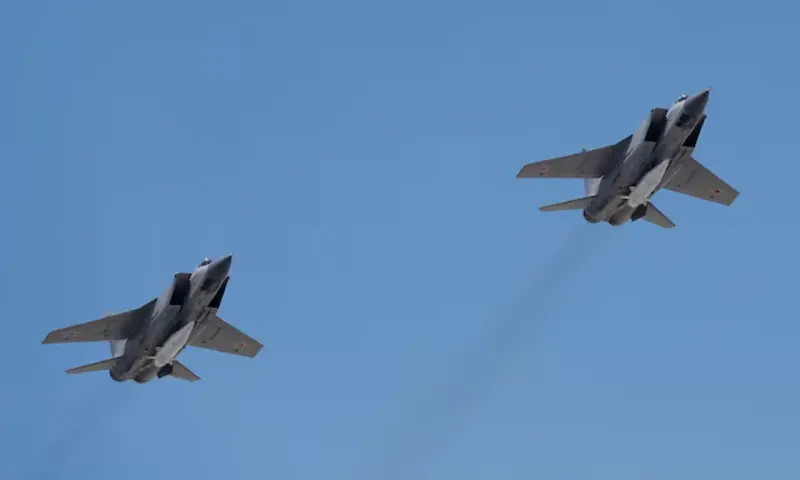
South Korean authorities issued an emergency warning on Tuesday after several Russian military aircraft entered the country’s air defence identification zone, triggering confusion when an official alert mistakenly identified the planes as North Korean.
The incident occurred near Ulleungdo Island in North Gyeongsang Province, where residents received emergency notifications amid concerns that foreign military aircraft were approaching South Korean airspace.
At around 8am local time (2300 GMT Monday), provincial authorities issued an alert referring to a suspected North Korean aircraft, informing residents that the plane had left the danger zone.
“The air raid alert for Ulleung County was lifted at 7:58am. Please resume normal activities,” the notification stated.
Approximately 40 minutes later, authorities issued a correction confirming that the aircraft involved were Russian rather than North Korean.
“It was Russian aircraft that violated the airspace,” the provincial authorities said in their clarification, without immediately explaining the reason for the mistaken identification.
Several major South Korean news organisations initially reported the incident as involving a North Korean military aircraft, relying on the government’s emergency notification before subsequently correcting their coverage.
South Korea’s military later clarified that several Russian military aircraft had entered the country’s Air Defence Identification Zone (KADIZ), but had not crossed into sovereign South Korean airspace.
Military officials also confirmed that no North Korean aircraft were involved in the incident.
An air defence identification zone extends beyond a country’s territorial airspace and is used to monitor and identify approaching aircraft. Entering such a zone does not necessarily constitute a violation of national airspace.
The initial warning caused concern because an actual incursion by a North Korean military aircraft would represent a significant development in relations between Seoul and Pyongyang, which remain technically at war following the 1950–1953 Korean conflict.
The mistaken alert came amid heightened military tensions along the heavily fortified inter-Korean border, following a recent landmine explosion in the Demilitarised Zone (DMZ) that injured three South Korean soldiers.
The episode highlighted the importance of accurate emergency communications, particularly in a region where military developments involving North Korea can quickly generate public anxiety.
Although the incident ultimately involved Russian aircraft operating outside South Korea’s sovereign airspace, the conflicting official notifications temporarily created uncertainty among residents and the country’s news media.