





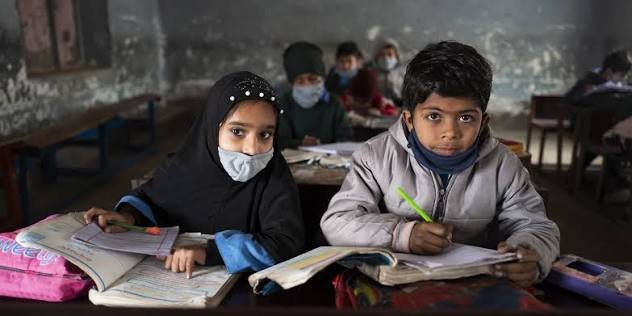
PREVENTING school dropouts requires more than identifying children who have already begun drifting away from the classroom. It requires recognising the warning signs early, diagnosing the underlying causes, and intervening before disengagement turns into permanent exclusion from education. With this objective, the Global Partnership for Education (GPE), in collaboration with UNICEF and with the support of the Balochistan education department, has introduced a dropout-prevention and early-warning system in government schools.
The initiative centres on three indicators — attendance, behaviour and assessment. Schools are provided with tablets and OMR registers to systematically record these indicators, enabling teachers and education authorities to identify children at risk of dropping out and, where necessary, intervene through parents, teachers, or the wider community. The approach is both timely and commendable. A child rarely abandons school without warning; the challenge is to recognise those warnings before it is too late.
Yet visits to government schools on the outskirts of Quetta reveal a disquieting contradiction between the sophistication of the intervention and the conditions in which it is expected to operate.
During monthly surveys and monitoring visits, several schools were found to be operating in severely dilapidated buildings, while some lacked even adequate shelter. Desks and chairs were conspicuously absent, leaving children to sit on the floor. In the scorching heat of July, with temperatures reaching around 40°C, classrooms without fans or adequate ventilation offered little semblance of a conducive learning environment.
The shortage of teachers compounds the problem. In some schools, a single teacher is responsible for three or four grades and, in effect, for teaching every subject. The expectation that one individual can simultaneously manage multiple classes, provide meaningful instruction, monitor individual learners, and maintain the required records raises a fundamental question: what kind of educational progress can reasonably be expected under such circumstances?
The burden does not end with teaching. As part of the dropout prevention initiative, teachers are required to maintain OMR records, monitor students, and upload the collected data using tablets. In areas where internet connectivity and mobile signals remain unreliable, even the seemingly simple task of transmitting data can become a persistent obstacle. For teachers already stretched across several grades and subjects, additional reporting requirements risk turning a potentially useful intervention into another layer of administrative burden.
This is where the promise of technology encounters the limits of infrastructure. A tablet can facilitate data collection, but it cannot compensate for the absence of a classroom. An OMR register can identify an irregular student, but it cannot address the absence of a teacher, a fan, a desk, or a safe learning space.
More importantly, students cannot be expected to contemplate their future while sitting on the floor in extreme heat, without shelter or ventilation. Nor can a teacher be expected to deliver quality education across several grades while simultaneously fulfilling an expanding range of reporting and technological requirements.
There is, therefore, a danger in treating dropout prevention primarily as a matter of data. Data can tell us who is at risk, but the school environment often tells us why. If absenteeism, declining performance, or behavioural changes are warning signs, then poor infrastructure, teacher shortages, and an inhospitable learning environment must also be understood as systemic warning signs.
Considerable resources are being devoted to tablets, OMR sheets, software and teacher training. Such investments can undoubtedly strengthen monitoring and accountability. But technology must complement the foundations of education, not substitute for them. The sophistication of an early warning system means little if the school itself cannot provide the basic conditions necessary for children to remain there.
The dropout prevention initiative deserves appreciation for acknowledging that disengagement must be detected and addressed before a child disappears from the education system. But the same principle should apply to the system itself. The warning signs are already visible: dilapidated buildings, inadequate classrooms, teacher shortages, children sitting on bare floors, extreme heat, and unreliable connectivity.
If the objective is genuinely to prevent dropouts, intervention cannot begin only when a child’s name appears as a warning on an OMR register. It must begin by ensuring that every child has a functioning classroom, an available teacher, a place to sit, and an environment in which learning is possible.
The data may identify the children at risk. The conditions on the ground already explain why.