





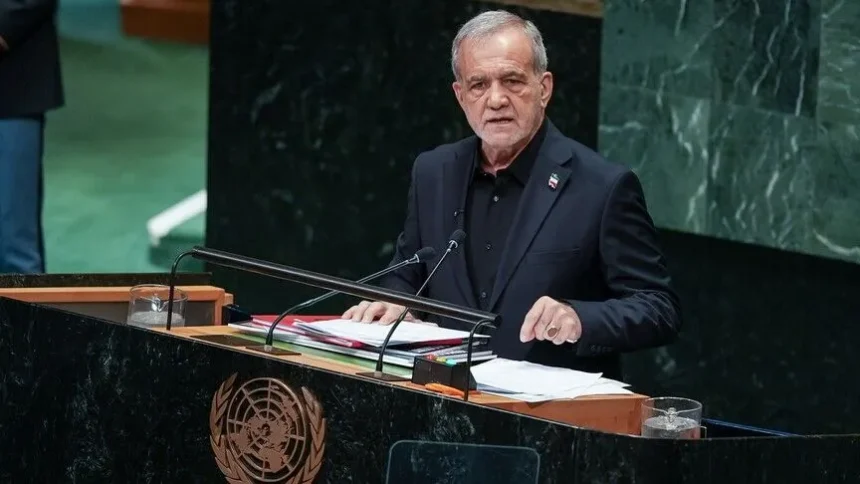
Iranian President Masoud Pezeshkian has said Tehran remains willing to resolve its dispute with Washington but argued that meaningful negotiations would require the United States to rebuild trust and demonstrate that it is not seeking regime change in Iran.
Speaking to CBS News after arriving in New York for the 81st UN General Assembly, Pezeshkian said both sides needed to honour previously agreed commitments.
The US “needs to show that it does not intend to overthrow our government or our administration,” he said.
Pezeshkian questioned Washington’s intentions, pointing to US military action and sanctions while diplomatic efforts were underway.
“Do you think the United States of America is genuinely interested in solving problems with us? Why, then, does it bomb us in the middle of negotiations? Why does it come and kill our scientists, officials and people?” he asked.
He also urged Americans to consider the conflict from Iran’s perspective, referring to the killing of Iran’s supreme leader during the war.
“Put yourself in our position. Imagine someone came and martyred your supreme leader. And then, not abide by everything you had agreed upon. What would be your reaction? It’s not something that can be resolved that simply.”
Pezeshkian said continuing sanctions, threats and military strikes made rebuilding confidence particularly difficult.
“As long as they don’t cease doing what they’re imposing on us every day, it’s difficult to trust them,” he said, questioning whether Washington would honour any future agreement.
Despite the tensions, the Iranian president expressed hope that peace could eventually be established across the region.
He also called on Washington to end its support for Israel, which he accused of carrying out what Iran considers genocide, and urged the US to “act on the basis of justice and fairness”.
The United States and Israel launched military operations against Iran on February 28, triggering Iranian retaliatory attacks against Israel and US sites across the region.
Diplomatic efforts subsequently produced a memorandum of understanding between Washington and Tehran in June, but negotiations later stalled. Among the major unresolved issues is navigation through the Strait of Hormuz, a critical route for global energy supplies and international trade.