





Lawyers representing Palestine Action co-founder Huda Ammori argued before the UK Supreme Court on Wednesday that the British government’s decision to classify the protest organisation as a terrorist group was excessive and threatened fundamental freedoms.
Barrister Raza Husain KC told a five-judge panel that Palestine Action’s methods were comparable to those historically employed by the suffragettes and other protest movements campaigning for political and social change.
He maintained that the organisation had never encouraged violence against individuals or attacks on their homes.
Husain pointed to the history of direct-action campaigns by anti-war protesters, environmental organisations and animal rights activists, arguing that some had used similarly disruptive or more extreme methods without being designated terrorist organisations.
The legal challenge concerns the government’s decision to proscribe Palestine Action under terrorism legislation, placing it on the same list as organisations including al-Qaida and Boko Haram.
Ammori’s legal team argued that the designation was disproportionate and interfered with rights to freedom of expression and peaceful protest.
Husain also warned that the ban had discouraged wider expressions of solidarity with Palestinians, creating uncertainty for journalists, academics, artists and campaigners who had no direct involvement with Palestine Action.
Representing Home Secretary Shabana Mahmood, James Eadie KC defended the government’s decision, maintaining that the designation was legally justified and proportionate.
He referred to criminal convictions involving four activists, including one for grievous bodily harm, and cited a judicial finding of a “terrorist connection” in proceedings arising from an attack on an Elbit Systems factory in Filton, near Bristol.
Palestine Action describes itself as a direct-action movement targeting companies involved in supplying equipment to Israel’s military.
The organisation attracted particular attention after activists entered RAF Brize Norton and sprayed red paint on two military aircraft, causing damage estimated at £7 million ($9.3 million).
The Labour government, then led by Prime Minister Keir Starmer, banned Palestine Action in July 2025, making it the first direct-action protest organisation proscribed under Britain’s Terrorism Act.
The decision subsequently became the subject of a prolonged legal dispute.
In February, the High Court ruled that the ban was “disproportionate”, but the Court of Appeal reached a different conclusion in June, finding that the government’s decision was lawful.
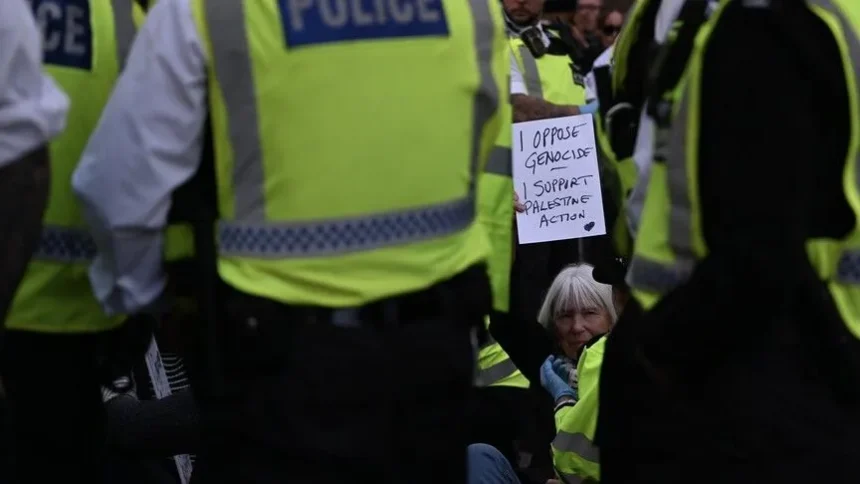
Wednesday’s proceedings also drew demonstrations outside the Royal Courts of Justice, where at least 25 protesters were arrested, including former Friends of the Earth director Jonathan Porritt.
The Supreme Court hearing is scheduled to conclude on Thursday, although judges are expected to deliver their ruling at a later date.
The case raises significant legal questions about the distinction between disruptive political protest and terrorism, as well as the limits of government powers to prohibit organisations involved in direct-action campaigns.