





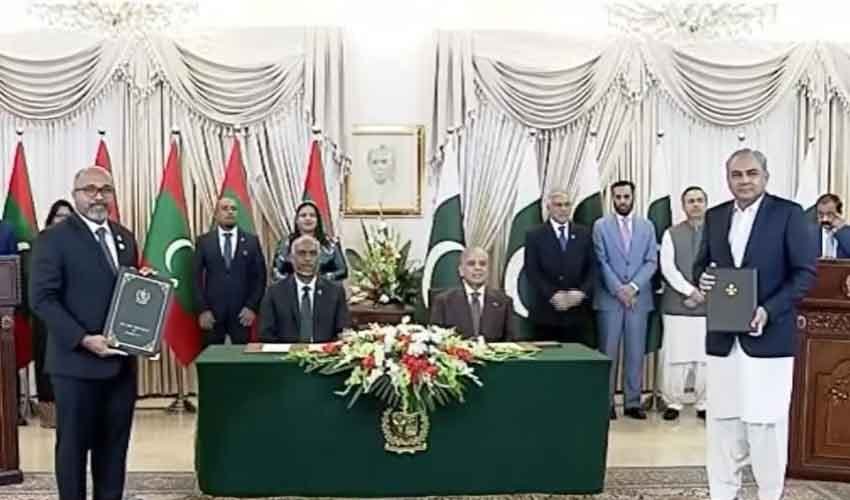
Pakistan and the Maldives have agreed to increase bilateral trade to $200 million within the next two years, while exchanging 20 memorandums of understanding (MoUs) and agreements covering economic development, technology, defence, healthcare and education.
The agreements were exchanged during Maldivian President Dr Mohamed Muizzu’s official visit to Islamabad, marking the first visit by a Maldivian head of state to Pakistan in 11 years.
Prime Minister Shehbaz Sharif welcomed President Muizzu at the Prime Minister’s House, where the visiting leader was presented with a Guard of Honour.
The two leaders subsequently attended a ceremony for the exchange of agreements aimed at strengthening cooperation across a wide range of sectors.
Technology, Healthcare and Security Cooperation
Among the key areas covered by the agreements are information technology, cybersecurity and artificial intelligence, reflecting both countries’ interest in expanding digital cooperation.
The two sides also agreed to strengthen collaboration on drug control, social protection and pharmaceutical regulation, including cooperation between the Drug Regulatory Authority of Pakistan (DRAP) and the Maldives Food and Drug Authority.
Additional agreements focus on recruiting medical professionals, expanding defence cooperation and improving maritime security.
Agriculture and fisheries were also identified as priority sectors for bilateral collaboration.
Education, Aviation and Cultural Exchanges
Pakistan and the Maldives further agreed to deepen cooperation in technical and vocational training, higher education, youth development and sports.
Other agreements address air connectivity, fine arts, cultural heritage and institutional cooperation between the two countries’ civil service commissions.
The arrangements are intended to facilitate professional exchanges, strengthen institutional partnerships and create new opportunities for businesses in both countries.
The visit comes as Pakistan and the Maldives mark six decades of diplomatic relations, with both governments seeking to translate their longstanding ties into broader economic and strategic cooperation.
The $200 million bilateral trade target represents a central economic objective of the renewed partnership, while the 20 agreements establish a framework for expanding collaboration across multiple sectors.