





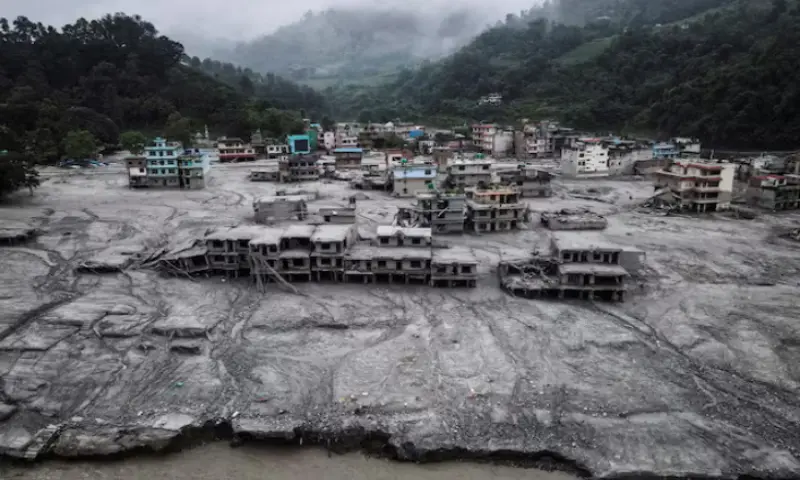
Nepal is set to receive $20 million in financial assistance from a United Nations climate fund following a catastrophic flood along its border with China’s Tibet region in August, the government announced late Thursday.
The disaster, which struck on August 26, claimed approximately 1,500 lives, while more than 5,000 people remain missing, according to figures cited by Reuters.
Official data indicates that the flooding affected nearly 60,000 people from 15,000 families, causing widespread destruction to homes, infrastructure and essential public services.
The government estimates that damage to infrastructure alone amounts to approximately $2.7 billion, with roads, bridges, schools and 13 hydropower plants among the facilities affected.
Preliminary assessments suggest that the overall cost of reconstruction could exceed $4.7 billion, highlighting the enormous financial challenge facing the Himalayan nation.
The $20 million allocation will come from the Fund for Responding to Loss and Damage (FRLD), an international financing mechanism established to assist vulnerable countries facing the consequences of climate-related disasters.
Despite the financial support, the allocation represents less than 1% of Nepal’s estimated reconstruction requirements.
In a statement, Nepal’s Ministry of Agriculture, Forests and Environment said the assistance was intended to “help address the severe damage caused by climate-related disaster.”
The government had formally requested support from the fund in August, submitting its appeal less than a week after the devastating floods.
The funding is expected to contribute towards addressing the disaster’s consequences, although substantial additional resources will be required to rebuild damaged infrastructure and restore essential services.
Prime Minister Balendra Shah, 36, raised the issue during his first address to the United Nations in September, describing the disaster as a warning about the growing dangers associated with climate change.
Shah argued that Nepal was suffering severe consequences from climate-related events despite contributing only a negligible share of global greenhouse gas emissions.
His remarks highlighted the challenges faced by countries that have contributed relatively little to global emissions but remain highly vulnerable to extreme weather events.
The disaster has intensified concerns about the financial burden of climate-related destruction, particularly for developing countries with limited resources to fund large-scale recovery programmes.
With thousands of people still unaccounted for and reconstruction costs running into billions of dollars, Nepal faces a prolonged recovery effort as it seeks further international assistance.