





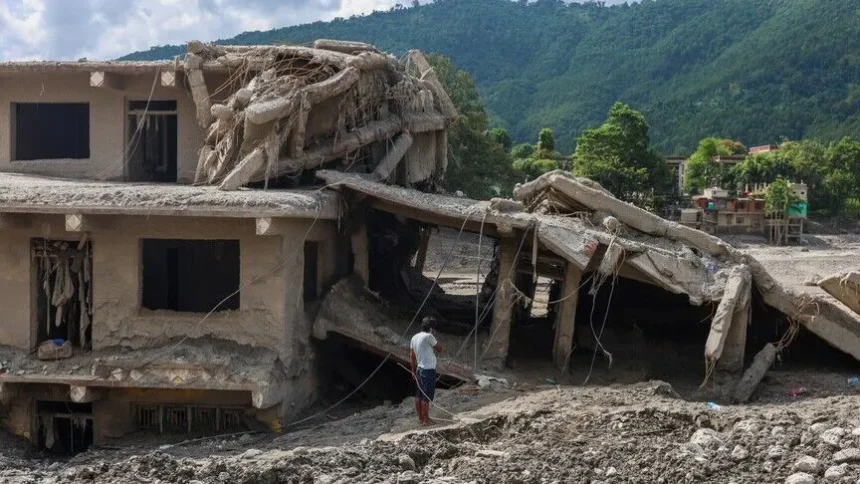
The death toll from catastrophic floods and mudslides along the Nepal-China border has surpassed 1,000, with more than 4,400 people still missing a week after the disaster devastated Himalayan communities and critical infrastructure.
Nepal’s National Disaster Risk Reduction and Management Authority (NDRRMA) said on Tuesday that another 84 bodies had been recovered, raising the confirmed death toll on the Nepalese side to 987.
Another 3,916 people remain missing in Nepal, including 583 foreign nationals and 639 personnel who had been deployed at hydropower facilities in affected areas.
Across the border, Chinese authorities have confirmed 16 deaths, while 546 people remain unaccounted for in southwestern Tibet, including 261 foreigners.
Combined figures from Nepal and China put the death toll at 1,003, with 4,462 people still missing, including 844 foreign nationals.
The disaster began on August 26, when a glacier on Nepal’s Mount Langtang Lirung fractured at an altitude of about 5,200 metres. The resulting ice-and-rock avalanche developed into a massive debris flow that swept through valleys along the border.
Floodwaters and mudslides caused extensive destruction across Rasuwa, Nuwakot, Dhading, Kavre and the Kathmandu Valley. On the Chinese side, the disaster buried the Gyirong border crossing in Tibet, also officially known in China as the Xizang Autonomous Region.
Indian nationals make up the largest identified group of missing foreigners, with 275 Indians unaccounted for. Around 100 Chinese nationals are also reported missing, according to figures released by the two countries.
The rapidly increasing number of bodies recovered has prompted Nepal to seek additional freezers, DNA testing equipment, drones and remote-sensing technology to assist with victim identification and mapping of inaccessible disaster zones.
China, India and South Korea have deployed teams to support search and rescue operations.
Rescuers continue to face severe logistical difficulties as landslides, destroyed roads and damaged communications infrastructure restrict access to some of the worst-hit areas.
The scale of destruction around the Gyirong border crossing has been particularly severe. Rescue personnel interviewed by Chinese state media said teams had to walk for around 10 hours to reach the area and, upon arrival, found virtually no trace of buildings or other infrastructure that had previously stood there.