





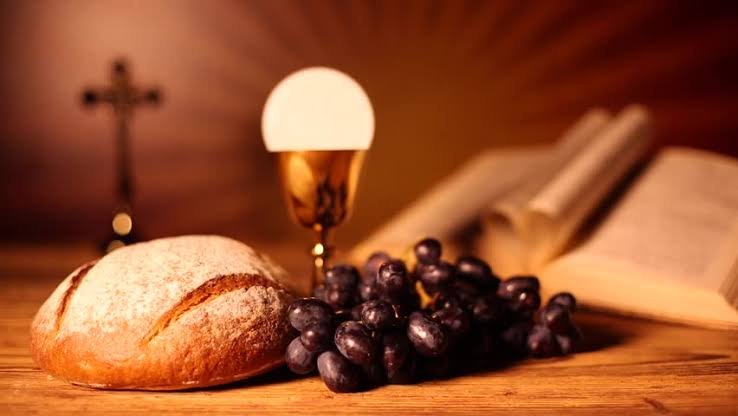
Holy Communion, also known as the Eucharist or the Lord’s Supper, is a central Christian rite. Believers eat bread and drink wine (or grape juice) to remember Jesus Christ’s sacrifice on the cross, following His commands from the Last Supper.
– Eucharist is a Greek word meaning “thanksgiving.”
– The Lord’s Supper: Reflects its origin at the Last Supper before Jesus’ crucifixion.
– Holy Communion: Emphasizes unity with Christ and fellow believers.
– The Elements: The bread represents the body of Jesus, the wine or juice represents His shed blood.
Denominational Views
– Catholic and Orthodox believe the bread and wine become the actual Body and Blood of Jesus Christ (transubstantiation or real presence).
– Protestant: View the practice as a sacred memorial or spiritual remembrance of Christ’s finished work, though specific views on His presence vary by tradition.
The Mystery of Melchizedek
Melchizedek, king of Salem (ancient Jerusalem), brought out bread and wine for them; he was the priest of Yahweh Most High (Genesis 14:18-20). Melchizedek symbolizes the eternal union of kingship and priesthood, serving as a biblical foreshadowing of Jesus Christ.
– King of Righteousness: His name translates from Hebrew (Melekh and Zedek) to mean “King of Righteousness.”
– King of Peace: As the ruler of Salem (which translates to peace), he represents peace and wholeness.
– Bread and Wine:His offering of bread and wine to Abraham symbolizes hospitality, victory, and an early shadow of Communion.
– The Dual Office: He uniquely combines the role of king and priest before the establishment of the formal Levitical priesthood, mirroring the future eternal priesthood of Christ.
– The Seal of Melchizedek: In some traditions, such as Latter-day Saint symbolism, an eight-pointed star formed by two overlapping squares represents the eternal authority of the Melchizedek priesthood.
When we discuss Holy Communion regarding Roman Catholicism, it is very crucial to talk about The Constitution on the Sacred Liturgy of the Second Vatican Council, held from October 11, 1962, to December 8, 1965, at St. Peter’s Basilica in Vatican City. It was convened by Pope John XXIII, opened by him and closed by Pope Paul VI, meeting across four separate autumn sessions between 1962 and 1965. The main purpose, known as aggiornamento (bringing up to date), was to spiritually renew the Catholic Church and adapt its practices to the modern world.
The Second Vatican Council also commented on the Eucharistic Sacrifice of the Altar as follows:
“At the Last Supper, on the night when He was betrayed, our Savior instituted the Eucharistic sacrifice of His Body and Blood. He did this in order to perpetuate the sacrifice of the Cross throughout the centuries until He should come again, and so to entrust to His beloved spouse, the Church, a memorial of His death and Resurrection, a sacrament of love, a sign of unity, a bond of charity, a Paschal banquet in which Christ is eaten, the mind is filled with grace, and a pledge of future glory is given to us.”
“The Church, therefore, earnestly desires that Christ’s faithful, when present at this mystery of faith, should not be there as strangers or silent spectators; on the contrary, through a good understanding of the rites and prayers they should take part in the sacred action, conscious of what they are doing, with devotion and full collaboration. They should be instructed by God’s Word and be nourished at the table of the Lord’s body; they should give thanks to God; by offering the Immaculate Victim, not only through the hands of the priest but also with him, they should learn also to offer themselves; through Christ the Mediator, they should be drawn day by day into ever more perfect union with God and with each other, so that God may be all in all” (Nos. 47-48).
Martin Luther’s Words for the Sacrament of Holy Communion, known as the Words of Institution, are taken from Luther’s Small Catechism as recorded by the Evangelists and St. Paul. Martin Luther emphasized that the Words of Institution, combined with eating and drinking, form the core of the sacrament. He taught the real presence of Christ’s true body and blood “in, with, and under” the bread and wine, and that the promises attached deliver forgiveness, life, and salvation to believers.
In John Calvin’s theology, an “altar” does not exist in Christian worship; it is strictly a Communion Table. Calvin and other Protestant Reformers actively replaced stone altars with wooden tables. This physical shift reflects a massive theological transition from the Roman Catholic Mass to the Reformed Sacrament of the Lord’s Supper (Holy Communion).
Table vs. Altar — Why the Difference Matters
To understand Calvin’s reforms, one must understand why he rejected the word “altar”:
1. An Altar Implies a Sacrifice:In medieval Catholic theology, the altar was where the priest re-offered the sacrifice of Jesus Christ to God.
2. A Table Implies a Banquet: Calvin argued that Jesus died “once for all” on the cross. Therefore, no new sacrifice is needed. The Communion Table is not a place where we offer anything to God; it is a spiritual banquet table where God feeds us.
Calvin’s Theology of Holy Communion: “Real Spiritual Presence”
Calvin rejects the view that the bread and wine literally turn into flesh and blood (transubstantiation). However, he also rejects the idea that Communion is just an empty memory exercise (memorialism). He taught a unique middle ground, often called Real Spiritual Presence.
– The Work of the Holy Spirit: Calvin taught that because Jesus ascended into heaven, His physical body stays there. During Communion, the Holy Spirit bridges the gap between heaven and earth. The Spirit lifts the believer’s heart up to heaven to feed spiritually on Christ.
– True Nourishment: The bread and wine are not empty props. They are objective instruments. When a believer eats the bread by faith, their soul is genuinely nourished by the life of Jesus, just as the physical body is nourished by bread.
Comparison: Altar vs. Table
Feature The Altar (Roman Catholic View) The Communion Table (Calvinist / Reformed View)
Primary Meaning A place of sacrifice where a priest represents Christ, offering to God A place of fellowship and feeding where God provides a spiritual banquet for people
Role of Minister Priest acting as an intermediary to offer the sacrifice Minister / Pastor who “fences” and serves the table
Direction of Grace Man offering something to God God pouring down grace to nourish human faith
Status of Christ’s Sacrifice Participation in an unbloody representation of the sacrifice Once-for-all historical event on the cross; it cannot and need not be repeated
Pillars of Calvin’s Theory of the Table
– A Spiritual Banquet, Not a Sacrifice: Calvin taught that the Lord’s Supper is a divine gift. Because Christ died once for all on the cross, the church does not need an altar to repeat or re-present that sacrifice. Instead, the table is a place where believers pull up a chair to eat a spiritual meal.
– The Real Spiritual Presence: Calvin rejects the Catholic view of transubstantiation (that bread becomes actual flesh) and the Zwinglian view (that the bread is merely a memory symbol). He argued for a real, spiritual presence. Christ’s physical body remains in heaven, but through the power of the Holy Spirit, the believer’s soul is lifted up to partake of the true life of Christ.
– Instrument of Assurance and Growth: The elements on the table act as a “visible Word” and a seal of God’s promises. When a believer eats the bread in faith, the Holy Spirit simultaneously feeds their soul with the benefits of Christ’s life and death.
– Frequency of the Meal: Because Calvin viewed the table as essential “medicine for the sick” and nourishment for weak faith, he famously argued that Holy Communion should be celebrated at least once a week, rather than the rare quarterly or annual practice common in his era.
Tradition / Denomination and What Happened to Bread & Wine
1. Roman Catholic — Transubstantiation
Roman Catholic theology teaches the strongest form of objective real presence. At consecration, the entire substance of the bread becomes the Body of Christ and the entire substance of the wine becomes His Blood. The outward appearances — taste, color, texture — remain bread and wine, but their underlying substance has changed. The Catholic Catechism says Christ is present “true, real, and substantial,” with His Body, Blood, Soul, and Divinity. This change is called Transubstantiation. Important texts include Matthew 26:26, Matthew 26:28 “This is my blood of the covenant,” John 6:53-56, 1 Corinthians 10:16, and 1 Corinthians 11:27-29. The Eucharist is also understood sacrificially, not as Christ being crucified again, but as the once-for-all sacrifice of Calvary being sacramentally made present.
2. Eastern Orthodox — Real Presence as Holy Mystery
Orthodox Christianity also teaches that Communion is truly Christ’s Body and Blood. Orthodox theology generally does not insist upon the Roman Catholic Aristotelian explanation of “substance” and “accident”; instead, it emphasizes mystery. The Holy Spirit is invoked over the gifts in the epiclesis, and the Church believes God truly makes them Christ’s Body and Blood. Catholic: “We can describe the change as transubstantiation.” Orthodox: “A real change occurs, but it remains ultimately a divine mystery.”
3. Lutheran — Sacramental Union / Real Presence
Lutherans strongly reject the idea that Communion is merely symbolic. They teach that Jesus literally meant, “This is my Body.” Lutheran theology teaches that Christ’s true Body and Blood are genuinely received together with the bread and wine, often summarized as “in, with, and under the bread and wine.” Bread remains bread, wine remains wine, yet Christ’s Body and Blood are truly received.
4. Anglican / Episcopal — Real Reception by Faith*
Anglicanism historically occupies a middle position. The Thirty-Nine Articles reject Roman Catholic transubstantiation while affirming genuine participation in Christ. Classical Anglican theology argues that “bread remains bread and wine remains wine,” but believers genuinely participate in Christ through faith.
5. Presbyterian / Reformed — Real Spiritual Presence
This is the view associated especially with John Calvin. The bread remains bread and the wine remains wine, but through the Holy Spirit, believers genuinely participate in the risen Christ.
6. United Methodist / Wesleyan — Means of Grace
United Methodists describe Holy Communion as a sacrament and means of grace. It is not merely “we think of Jesus.” Rather, Christ genuinely ministers grace to His people through Communion. The emphasis is: Christ meets us, Christ gives Himself, the Holy Spirit works, the Church remembers Christ’s death, and the Church anticipates His coming Kingdom.
7. Baptist — Memorial / Symbolic Ordinance*
The Baptist position calls the Lord’s Supper “a symbolic act of obedience.” The bread and juice symbolize Christ’s Body and Blood, memorialize Christ’s death, and anticipate Christ’s Second Coming.
8. Assemblies of God / Pentecostal — Symbolic Ordinance with Spiritual Participation
The Assemblies of God officially calls Holy Communion an ordinance, not a sacrament in the Catholic/Lutheran sense. Its Statement of Fundamental Truths says the bread and juice are symbols expressing participation in Christ, a memorial of His suffering and death, and a prophecy of His second coming.
9. Seventh-day Adventist — Symbolic Emblem + Christ’s Spiritual Presence
Adventists call the bread and grape juice emblems of Christ’s Body and Blood. A distinctive Adventist feature is foot washing before Communion, called the Ordinance of Humility, based on John 13.
10. Latter-day Saints (LDS) — The Sacrament
LDS observe a communion-like ritual known as the sacrament. Instead of wine, they normally use water with bread. The purpose is primarily to remember Christ’s Body and Blood and renew baptismal covenants.
11. The Salvation Army does not practice Holy Communion during its regular worship service. It teaches that God’s grace is open to everyone without needing physical ceremonies, and that everyday life with Christ living inside a person is the true sacrament.
The Four Major Theological Positions
1. Transubstantiation: Bread/wine truly changed in substance into Christ’s Body/Blood.
2. Real Presence / Sacramental Union: Eastern Orthodox and Lutheran, though their explanations differ significantly. Christ’s Body and Blood are objectively and truly given.
3. Real Spiritual Presence: Reformed/Presbyterian, much of Anglicanism, Methodist/Wesleyan. Bread and wine remain what they are, but Christ genuinely communicates Himself/grace spiritually through the Holy Spirit.
4. Memorial / Symbolic Ordinance: Baptist, Assemblies of God, many Pentecostal and Evangelical churches, Adventist. Bread and cup represent Christ’s Body and Blood and proclaim His death without becoming them.
Where the Theological Debate Really Centers
The biggest passages are not only “This is my Body.” There are crucial texts: Matthew 26:26-28, John 6:53-58 “Unless you eat the flesh of the Son of Man and drink His Blood,” 1 Corinthians 10:16 “The cup of blessing, is it not a participation (koinonia) in the blood of Christ?”, 1 Corinthians 11:27-29 “Whoever receives unworthily is guilty concerning Christ’s Body and Blood,” and Luke 22:19 “Do this in remembrance of me.”
So the central theological question is not whether Communion is remembrance — virtually everyone agrees that it is. The real question is: Is Communion only remembrance, or does the believer actually participate in Christ in a special way through the bread and cup?
Why Jesus Wanted Us to Eat His Flesh and Drink His Blood
John 17:21-23, “That they all may be one, as You, Father, are in me, and I in You, that they also may be one in Us…” Jesus prays for believers to share in the divine unity He has with the Father.
When a person eats any food, the body breaks it down into small pieces and uses those pieces to build new cells and make energy. Digestion starts in the mouth, the stomach breaks it down, blood carries nutrients everywhere, and cells use the parts. But our Jesus Christ blesses us spiritually.
We could not have a more instructive commentary than St. Augustine’s: “This then it is, to eat that meat and drink that drink, namely to dwell in Christ, and to have Christ dwelling in us. And therefore he who dwelleth not in Christ, and in whom Christ dwelleth not, without doubt doth neither eat His flesh nor drink His Blood, but rather doth unto judgment to himself eat and drink the sacrament of so great a thing.”_
John 6:56, “Whoever eats my flesh and drinks my blood remains in me, and I in them.” Jesus Christ certainly did not intend to make His believers cannibals, but wanted a deep, permanent spiritual union and total reliance on Jesus. This metaphor was not understood when He was teaching at Capernaum, stating how He can give us His Body and Blood to drink, and many left Jesus, including many of His disciples. But many stayed with Jesus, and when Jesus asked why they did not go, Peter said, “Where can we go? Because you have everlasting life,” because Jesus said “I am the Bread of Life.”
Strategy
I humbly state that only to rule and to prove themselves unique, all denominations have worked on the Lord’s Body and Blood. As Ephesians 4:14 says, Apostle Paul challenges believers to move away from spiritual immaturity, using powerful imagery of a stormy sea and deceptive teachers: “So that we may no longer be children, tossed to and fro by the waves and carried about by every wind of doctrine, by human cunning, by craftiness in deceitful schemes.”
The Sacrament Itself
To nourish this relationship, He instituted the Sacrament of the Eucharist. He was eager, as seen in Luke 22:15-20, Matthew 26:17-20, Mark 14:12-25, John 13, and 1 Corinthians 11:23-25: “And He took bread, gave thanks and broke it, and gave unto them, saying, ‘This is my Body, which is given for you: this do in remembrance of me.’ Likewise also the cup after supper, saying, ‘This cup is the New Testament (covenant) in my Blood, which is shed for you.'”
Jesus Christ in His Last Supper only gave bread and wine (juice of grapes) at that time, and His divine words bless and raise so high that all partakers of that Holy Meal felt Jesus in them, and the same is happening till now, and will happen forever. Many times during hard times, when bread and juice of grapes (wine) are not available, pastors are seen using a single grain of rice as the Body of Jesus Christ and simple water as the Blood of Jesus Christ, and the believers enjoy the divinity of Jesus’ Blood and Body. Only raise your faith.
Apostle Paul states a warning to believers in his first letter to the Corinthians 11:27-29: “Wherefore whosoever shall eat this bread and drink this cup of the Lord unworthily shall be guilty of the Body and Blood of the Lord. But let a man examine himself, and so let him eat of that bread and drink of that cup. For he that eateth and drinketh unworthily, eateth and drinketh damnation to himself, not discerning the Lord’s body.”
Just read: the man unworthy of Jesus Christ who partook in the Lord’s Supper, and he was given the sacrament by Jesus Himself, and due to his sin in his heart, he (Judas Iscariot) hastened to complete his mission. And Jesus said about him, Luke 22:22, “And truly the Son of man goeth, as it was determined: but woe unto that man by whom He is betrayed.” So when you are partaking of the Body and Blood of Jesus Christ, examine yourself, and go to your Rev. Father, Priest or Pastor, confess your sin as advised and instituted by our Lord Jesus Christ to abolish sin (John 20:22-23), and receive forgiveness of sin from Jesus Christ through your pastor, to whom with His breath He has blessed with authority to forgive sins and authority not to.
Remember when you take the Sacrament of the Body and Blood of Jesus Christ, you have Jesus in you, and when Jesus is in you, you have no want.