





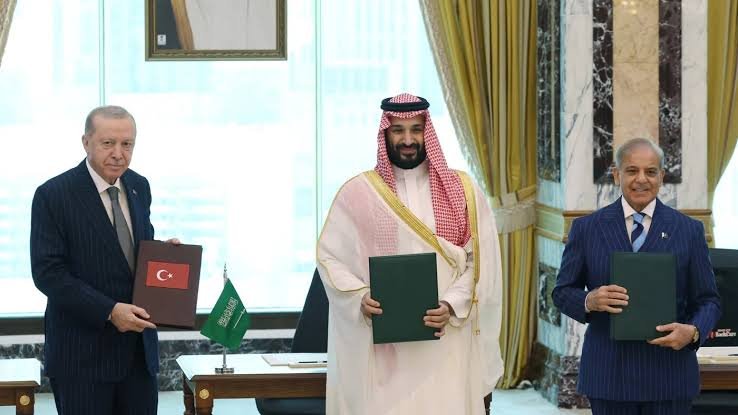
The importance of the recent agreement between three countries — Saudi Arabia, Pakistan, and Türkiye — is undeniable, but more than that, what is significant is the timing of this deal. The strategic partnership came about at a time when the Middle East is grappling with chaos, and any other moment is unpredictable.
This is the most sensitive situation unfolding since the Arab Spring of 2010. The parties to the agreement have shown great support for each other; however, what is crucial is the future of this mutual accord. What impacts would it exert on Pakistan and its policies towards the Middle East during the ongoing conflicts? How would Pakistan manage its relationship with Iran, a country that has always had troubled relations with Saudi Arabia? And how effective would this agreement be while Türkiye is a NATO member? These questions highlight the parameters and challenges this trilateral cooperation would have to live through to be successful enough to achieve its intended outcomes; otherwise, it would be just another carefully inked document.
Pakistan has always tried to maintain cordial relationships with Middle Eastern countries, not just for geo-economic purposes, but also for religious affiliation. This has been the driving force behind mutual agreements signed over the years, particularly since last year. However, a lot of potential in these mutual relationships remains untapped.
Pakistan has been emerging as a leading state, making efforts to bring peace to the region whether through the brokering of the Doha Accord or the signing of the Islamabad MoU between Iran and the USA. Peace in the Middle East has been one of the imperative pillars of Pakistan’s foreign policy. The region is home to millions of Pakistani diaspora, with Saudi Arabia and the UAE alone accounting for more than half of the remittances to the country. On the other hand, Iran is an immediate neighbour with close territorial and cultural proximity, as well as a gateway to the Central Asian Republics (CARs). When it comes to Pakistan’s policy towards India and Afghanistan, Iran becomes highly relevant.
Attack on One Will Be an Attack on All
On the face of it, the Mecca Defence Agreement is an ideal situation where all three Islamic states stand together. The clause “an attack on one will be an attack on all” — capturing the spirit of the French phrase “un pour tous, tous pour un” — highlights unconditional solidarity. But here lies the original challenge that needs to be tackled strategically. Considering the past to analyse the future, there will be chances for a situation like the Yemen crisis of 2015, where Pakistan has to make tough choices. If such a situation appears, what stance would Pakistan take, and whose side would it choose? The ongoing US–Iran conflict would be a significant variable to consider while making any choice.
On the other hand, it gives Pakistan the leverage to create deterrence against participating countries indulging in any chaotic situation. Whatever shape this trilateral partnership takes will depend on the leadership and bargaining power of the participant countries. Among all the uncertainties, one thing is certain: any wrong move would have far-reaching consequences, with a ripple effect extending across both South Asia and the Middle East.