





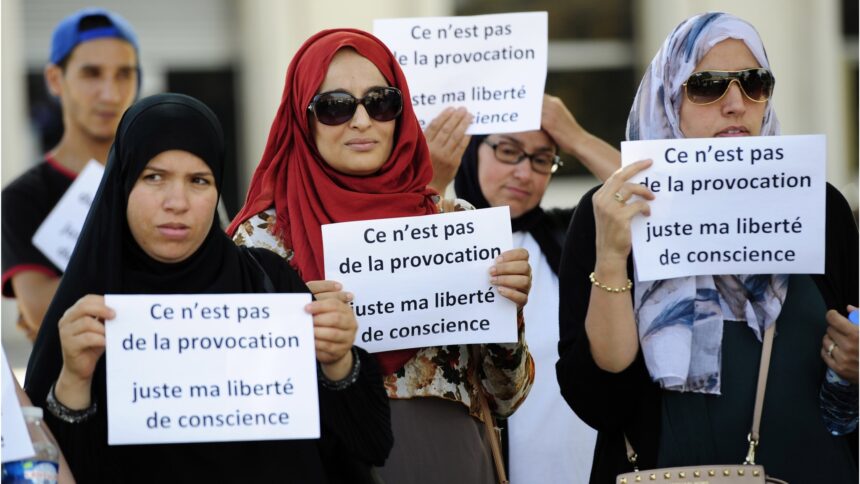
Beyond the Western Gaze: If people in the West ever looked at me, they would probably see a girl in a hijab. For them, this piece of cloth, an integral part of my identity, resonates more powerfully than my voice and thoughts. To them, it is not a personal choice or an act of faith. Instead, it symbolises my silence, submission, and oppression — a pervasive narrative that has been falsely ingrained in Western societies. Unfortunately, it has also been absorbed by many of our own, mainly the local elites, who believe that following in the footsteps of Western culture and mimicking them makes them ‘cooler’ and acceptable. According to them, a hijabi is poor, illiterate, and blindly obedient.
This narrative is everywhere. It’s in the news that it claims to “liberate” Muslim women by urging them to remove their hijab, claiming they are “free” in their country, and they do not need to “terrorise” their free and secular neighbourhoods. It’s in the films where the hijabi women are portrayed as victims — voiceless, forced into a marriage, abused by their families — and she can only be ‘free’ when she throws off her hijab, takes a shot of tequila and is in a relationship with Tom.
From classrooms to courtrooms, fashion runways to political platforms, the hijab is constantly misunderstood and misinterpreted. It’s as if a Muslim woman’s freedom and voice have been labelled and judged. But in all these talks and arguments, the voice of the women who wear it is often absent, not because they are quiet but because no one will listen.
But the real question is: Is hijab truly an oppression or just a convenient narrative?
If you pose that question to a hijabi, the majority will either smile or respond with an enthusiastic explanation. This question is particularly ironic, considering the West prides itself on freedom of expression and identity; it cannot accept that for many Muslim women, the hijab is an expression of faith and identity, and sometimes, as history has shown us, a symbol of resistance.
To truly understand how this narrative became so deeply rooted and stereotyped, we need to revisit the histories that the world has forgotten — or deliberately erased.
There was a time in history when the veil stood for resistance. From Algeria to Pakistan, veiling became a symbol of resistance to imperial forces. During the Algerian War of Independence (1954–1962), French colonisers defined unveiling as civilisation and freedom. In response, many Algerian women chose to wear a veil as an act of rebellion. To them, it was not compromising their identity but was rather an assertion of cultural identity against their oppressive coloniser.
Beyond the Western Gaze
Likewise, in Iran, before the 1979 Revolution, veiling was banned under Reza Shah’s rule as part of a forced modernisation agenda that was heavily influenced by the West. Reza Shah harassed and, in many cases, forcibly unveiled women who wore the hijab in public. During the Iranian revolution, many women took to the streets, not just to demand political change, but also to reclaim their right to wear hijab, which had been banned, apparently, in the name of “progress”.
Yes, it is indeed true that the aftermath of the revolution brought its set of problems, including the compulsory hijab laws, which many Iranian women still protest against today. Nevertheless, the core fact remains: the veil, during the revolution, was not imposed on the people; rather, it was demanded by many of them as a rejection of Western imperialism and a way to protect their culture and identity.
In Pakistan, too, the veil has had complex meanings. During the British Raj, veiling wasn’t about hiding women; it was about preserving their culture and asserting religious freedom. While veiled, many women from educated, urban households actively participated in resistance movements, their voices louder than those of our colonisers.
We can’t deny the fact that our histories have been rewritten, forged, and reduced to a patriarchal narrative while boldly ignoring the religious, political, and spiritual dimensions of the veil. By further exploiting these ideas, the Western media — and some local elites, who thrive by seeking approval from that media — have distorted this symbol of identity and freedom into a mark of victimhood.
In Islam, hijab is not about control or backwardness — it’s about being liberated from the male approval or gaze and owning your beliefs and presence in a world that refuses to understand or create a space for them.
Therefore, the next time you see a hijabi, I urge you to pause before making any assumptions. Behind that piece of fabric might be a voice louder than yours — a heart and mind shaped by resilience and the courage to choose identity over conformity.