





Imagine the universe as an expansive library, with shelves meticulously arranged and books aligned with cosmic precision. However, left to itself, you would find books scattered, pages torn, and volumes lost. This is “entropy” — the gradual shift from order to disorder, from symmetry to chaos. It governs how heat flows, how stars burn, and ultimately, how the universe will end. Entropy obeys the second law of thermodynamics, which states that the net entropy of an isolated system tends to increase. But this law raises a deeper question. Why must it be so, and what does that mean for the future of everything around us?
Entropy is usually interpreted as messiness, but it’s the mathematics of probability. There is a single way to clean a child’s room, but a million ways to make it messy; the more possible arrangements, the more entropy. Nature follows the same rules; it tends to move towards states having more possible microscopic arrangements, which are called microstates. These are alternative ways in which tiny particles like atoms or molecules can arrange themselves, yet what we see on the surface stays the same. A renowned Austrian physicist, Ludwig Boltzmann, summarised the idea by giving a formula.
S = k × ln(Ω)
- Here S is entropy
- k is Boltzmann’s constant
- ln is the natural logarithm
- Ω (omega) is the number of possible microscopic arrangements
When you bring a hot cup of coffee into a cold room, the heat will be evenly spread in the room, which leads us to two things: first, as the heat spreads evenly, the hot cup of coffee is no longer hot anymore, and second, as the heat is distributed in the entire cold room, it means the entropy is increased.
Why do we only remember the past, not the future? Why does the broken cup not leap back together but always fall apart? The answer does not lie within Newton’s laws of motion but within entropy’s irreversible climb. When entropy increases, it defines the forward direction. This is called the Arrow of Time.
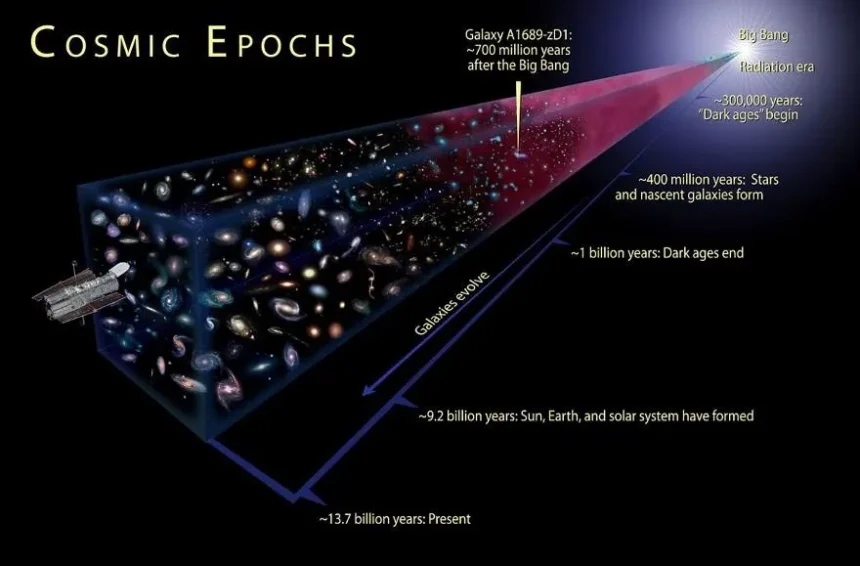
In the early universe, conditions were improbably synchronised; it was hot, smooth and low in entropy. Ever since silence gave way to chaos, every breath you take and every flicker of a star contributes to the chaos. Your life, your memories, and everything you know depend on the fact that entropy was low in the past and it’s increasing every second. If this hypothesis were not true, eggshells would not unbreak, smoke would not move back into a matchstick, memories would be erased, and time would seem to be moving backwards. This is something which is not going to happen because the number of higher entropy futures vastly outnumbers the past.
Entropy is not confined to kitchens or labs; rather, it governs stars, galaxies and even black holes. Whenever a star fuses hydrogen into helium, it radiates heat outward, exporting disorder into space. These burning giants maintain order while increasing overall entropy by exporting disorder into space. Even life on Earth, complex and structured, thrives by consuming low-entropy energy from the sun and ejecting it as higher-entropy waste.
As a star’s fuel is exhausted, it operates within defined constraints. They collapse into white dwarfs, neutron stars, or black holes’ echoless chambers of thermodynamic evolution. Black holes, once considered as entropy sinks, today are known to contain immense entropy. In fact, most of the entropy of the universe is stored in them.
And what happens when all fuel is depleted? Galaxies diverge, stars burn out, and black holes evaporate through Hawking radiation (a theoretical prediction). In this terminal stage, scattered over a trillion years, the universe evolves into cold, dilute, and uniform. This is the heat death, the final equilibrium where entropy can no longer rise, and no work, no framework, and no life can persist.
In the final breath of the cosmos, when the last star of the cosmos fades and the final black hole sizzles into radiation, the universe will attain its thermodynamic tombstone: maximum entropy. No gradients, no energy flows, no contrast, just a cold, diffuse, fading mist adrift in silence. This is the heat death, where everything is as destined and unremarkable as it can be.
But is this truly the end? Some cosmologists suggest the universe might reinvigorate through quantum fluctuations in the vacuum. Others hypothesised a Big Crunch, where gravity goes backwards in the expansion and reinitiates cosmic fire, or a Big Rip, shearing atoms before ever sealing its glory.
Entropy may write the final chapter of the cosmos, but it also generates its most vivid verses. Without the disparity of low entropy, there would be no stars, no life, no questions, and no answers. In a strange twist of fate, the very law that ensures the universe’s end is also what makes beauty, thought and existence possible.
Entropy is not the villain of the tale; it’s the narrator. It sculpts the arrow of time, propels the engine of life, and moulds the stage on which all things dance. Perhaps entropy is not what threatens life but what allows it.
The universe gradually transitions towards thermodynamic equilibrium, and we fugitive, conscious configurations of atoms find meaning in the temporary. We build, we love, we write.
Ultimately, entropy will prevail, but as of this moment, the stars are undergoing nuclear fusion, and perhaps that’s enough.