





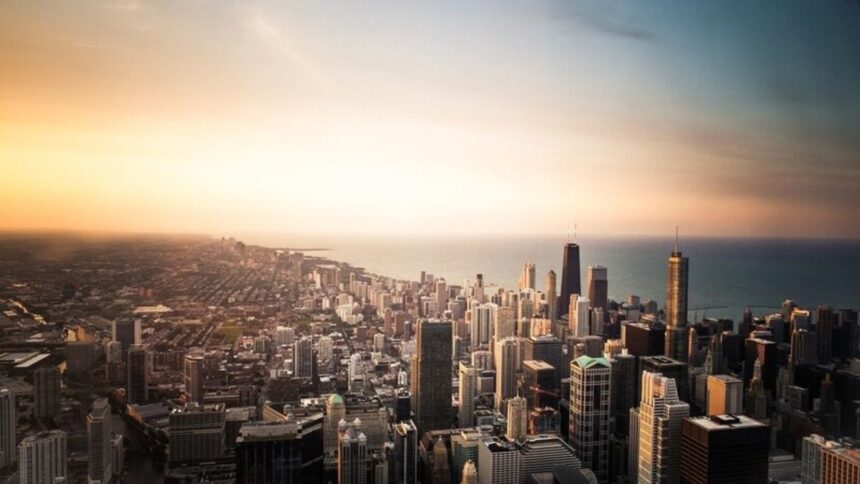
The metropolitan areas and big cities around the globe experience significantly higher temperatures than the surrounding rural areas; this is termed the ‘urban heat island (UHI) effect.’ According to the climate researchers, due to UHI, the temperature in the cities, on average, is 5.6℃ higher than in rural areas. Due to UHI, the heat waves are more intense in cities and last longer. This effect is observable, as the summer season has now become more intense and lasts longer.
The major reason for UHI is urbanisation-shift of large numbers of people from rural areas to urban areas, which drastically increases the population in the cities. People usually move to cities for better jobs, facilities, and lifestyles, leading to high population density. To manage the needs of a large population in cities, the infrastructure is built accordingly. The buildings have multiple floors, the streets are narrow, and the roads are made of asphalt and concrete. Such densely packed infrastructure increases the heat absorption by the buildings and concrete roads. It also reduces the effective air circulation in the atmosphere, leading to high temperatures.
The more the population, the more the number of transport vehicles, and in turn, the more the emission of nitrogen oxides, release of waste gases from industries, and emission of CFCs from the appliances (refrigerators, cooling systems). UHI increases due to these human activities, which in turn escalate the pressure on the consumption of energy resources for cooling purposes, which leads to UHI, and this cycle continues. UHI is not only damaging the environment, but it is also affecting human health, increasing the risk of heat strokes and, in severe cases, death due to intense heat waves.
UHI has forced climate researchers and governments to develop strategies in order to mitigate its harsh effects. In recent decades, two strategies have been widely adopted in the cities to reduce the UHI: cool roofs and green roofs.
Cool roofs are very reflective roofing materials used in order to minimise heat gain through reflection of sunlight. Cool roofs usually use light colored or advanced reflective dark material on the roofs. This strategy has proved to be very beneficial as it reduces the temperature and keeps buildings cooler. The researches have shown that cool roofs conserve up to 10%-15% of energy resources. In addition, cool roofs keep the temperature up to 28°C or more degrees cooler in summer.
“Green roofs” refers to planting vegetation on the roofs of buildings. These plantations naturally reduce the surrounding temperature through transpiration and increase its cooling effect. Santamouris, an architect and researcher, found that green roofs significantly reduce the roof surface temperature. This reduces heat flux in buildings and cooling system demands.
One more concern regarding UHI is that it is now not restricted to the heat islands only. The hot air currents from heat islands reach the high-altitude regions and affect the cold weather patterns there. It results in the gradually increasing temperature in the high-altitude regions, less snowfall and short-duration winters. The best example is the summer and winter seasons in Pakistan. In recent years, the northern areas experienced fast melting of glaciers and gradually increasing temperature in high altitude areas, less snowfall and short duration winters.
In order to control the effect of UHI, proper strategic implementation of mitigation interventions is needed to conserve the climate. Besides the cool roofs and green roofs, more plantations on road sides, in residential and commercial areas, should be promoted, as it will help to lessen the city’s temperature by the natural evapotranspiration process.
Governments around the world have also introduced policies regarding the city’s infrastructure, which include designing city layouts that improve ventilation and air circulation. These strategies have been beneficial in alleviating the urban heat island effect. But still, many other things, like irresponsible human activities, improper management of industrial waste and relentless use of energy resources, need to be controlled in order to make these strategies more effective.
There should be more eco-friendly technology and initiatives that help to protect our Earth from the harmful effects of human activities. In a nutshell, the Earth is our place to live, and natural balance is necessary for our survival; we should use the resources responsibly to make the Earth a safe place to live.