





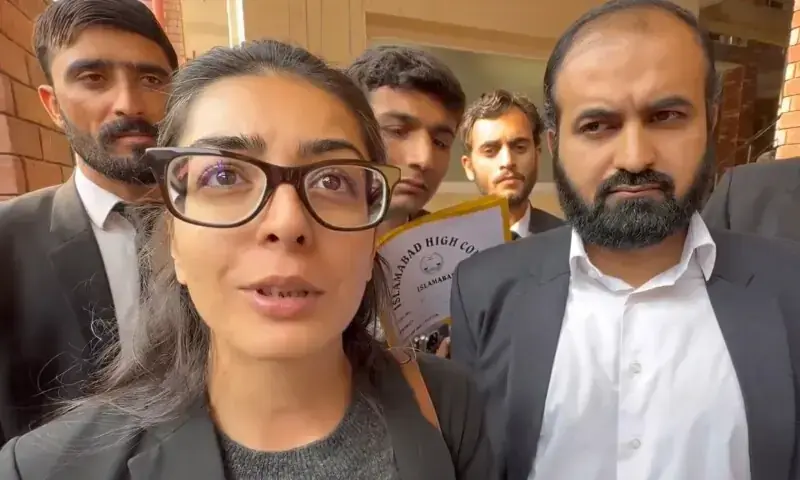
An anti-terrorism court (ATC) on Saturday instructed human rights lawyer Imaan Zainab Hazir-Mazari and her husband, Hadi Ali Chattha, to record their statements at the next hearing in a case involving an alleged breach of security arrangements for an international cricket team.
ATC Judge Tahir Abbas Sipra conducted the proceedings at Adiala Jail and adjourned the hearing until Monday, October 26, after both defendants declined to provide statements under Section 342 of the Code of Criminal Procedure (CrPC).
The provision allows a court to question accused individuals about evidence presented against them during criminal proceedings.
The case dates back to 2024 and concerns allegations that Imaan and Hadi interfered with security arrangements established for an international cricket team’s movement.
Prosecutors have accused the couple of removing barriers along the designated security route and engaging in conduct allegedly intended to incite public unrest.
Both defendants were formally indicted on October 7 and are currently facing trial at Adiala Jail.
During Saturday’s proceedings, Hadi requested that the prosecution record the required statement on the couple’s behalf.
“Let the state counsel record the statement under Section 342 on our behalf,” he told the court.
However, Judge Sipra rejected the request, explaining that statements under Section 342 must be recorded directly between the court and the accused.
The judge maintained that the defendants were required to respond personally to the court’s questions.
Imaan subsequently refused to provide a statement.
“We will not record the statement under Section 342,” she said.
Following the couple’s refusal, the judge warned that their failure to respond would be formally noted in the court’s order if they continued to decline.
He directed both defendants to record their statements at the next hearing and adjourned the proceedings until October 26.
The case remains pending before the anti-terrorism court, with the next hearing expected to address the defendants’ responses to the evidence presented against them.