



Pakistani astronaut Muhammad Zeeshan Ali has successfully completed a scientific experiment involving photosynthetic cyanobacteria aboard China’s Tiangong space station, marking another milestone in the country’s growing participation in international space research.
Ali carried out the experiment on Saturday, November 28, his fourth day aboard the orbiting laboratory, as part of the Shenzhou-24 mission involving scientific cooperation between Pakistan and China.
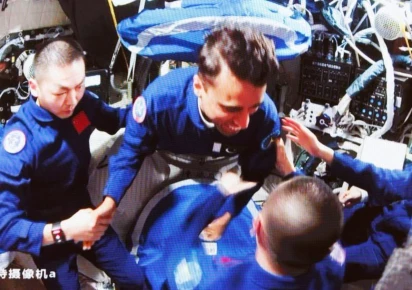
The astronaut arrived at Tiangong on Wednesday alongside Chinese astronauts Tang Hongbo and Wu Yi, becoming the first foreign national to board China’s space station.
The mission includes four joint scientific experiments covering biotechnology and advanced materials research, marking the first time such collaborative projects between Pakistan and China have been conducted aboard the station.
Pakistani researchers took the lead in designing the experimental procedures and defining their scientific objectives, while Chinese specialists provided the engineering and technical support necessary to conduct the studies in orbit.
Materials required for the experiments had been delivered to the space station before the crew’s arrival.
These included photosynthetic cyanobacteria, quinoa, graphene hybrid composite materials and carbon fibre composite materials.
One of Ali’s principal assignments involved examining the growth of photosynthetic cyanobacteria under the conditions experienced aboard the space station.
Having adjusted to the weightless environment, Ali moved through the station by pulling himself along handrails before entering the Wentian laboratory module to begin the experiment.
Meanwhile, scientific teams from Pakistan and China were stationed in Beijing to monitor the procedure and provide technical assistance.
Once communication between the space station and the ground-based researchers was established, Ali began conducting the experiment in coordination with the supporting scientists.
He retrieved the container holding the cyanobacteria samples and photographed their growth using a camera.
The images were transmitted to the ground, allowing researchers on Earth and the astronaut aboard the station to examine and interpret the observations together.
Following the prescribed experimental procedures, Ali gently shook the container before capturing another set of photographs and transmitting the images for further examination.
The successful completion of the procedure represents an important step in the joint research programme, which aims to investigate biological processes and the behaviour of specialised materials in the space environment.
Ali’s participation in the Shenzhou-24 mission also marks a significant development in Pakistan-China scientific cooperation, expanding their partnership into crewed spaceflight and experiments conducted in orbit.
The remaining joint scientific projects will further contribute to research in biotechnology and materials science as the two countries pursue their collaborative space programme.