




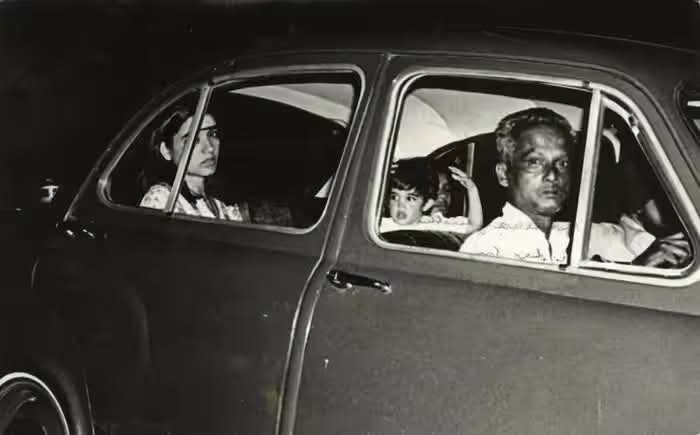
The New Yorker on Indira Maneka’s argument, which led to Indira ejecting her son’s widow, 23-year-old Maneka. Ved Mehta wrote about it based on Indian press articles. It appeared in The New Yorker on May 9, 1983.
This is what Ved Mehta wrote: (short snippet)
On the early afternoon of March 29, 1982, Prime Minister Indira Gandhi called her daughter-in-law Maneka to her office at the Prime Minister’s residence in New Delhi. Maneka had been widowed less than two years prior, at the age of twenty-three, when Mrs. Gandhi’s younger son, Sanjay, perished in the crash of a sports plane he was piloting. Since she married Sanjay, Maneka had lived with Mrs. Gandhi for seven years. However, on this particular occasion, Mrs. Gandhi yelled at Maneka to leave the house right now.
“What have I done?” Maneka enquired. “I’ve already told you everything.”
“You attended the convention, and now you have to deal with the fallout!” Mrs. Gandhi said. A couple of Sanjay’s irate supporters had organised the aforementioned gathering the day before. Mrs. Gandhi had expressed her opinion that the convention was a threat to her authority. Maneka had gone, claiming that it was just to promote Sanjay’s work and pay tribute to his memory.
The mother-in-law and daughter-in-law started yelling at each other over who was mistreating whom, what rights the daughter-in-law had in her mother-in-law’s home, and who was the mistress. Maneka’s two favourite dogs, Bruno and Sheba, growled and jumped around wildly. In the national daily Indian Express, prominent journalist Arun Shourie wrote, “The dogs . . . were specially unruly that day.” “It seems that they only pay attention to Maneka and a servant. . . . The servant was fired the night before.” (My description of that day’s events is based on what newspaper reporters overheard at the Prime Minister’s residence, their interviews with eyewitnesses, which were never formally refuted, and published letters and comments from the participants.)
Mrs. Gandhi clearly meant business. Two of her closest aides, R. K. Dhawan, her long-time private secretary, and Dhirendra Brahmachari (also known as Dhirendra “the Celibate”), her powerful yoga instructor, were in the office with her and appeared to be merely waiting to take Maneka out of the house.
At one point, Maneka pleaded for two days’ grace, stating that she needed time to pack and find a place to live since her two-year-old son, Varun (short for Feroze Varuna), who was born in 1980, had a temperature of 104. Mrs. Gandhi stated that only Maneka needed to leave and that she could move in with her mother; Varun didn’t need to go anyplace. Amteshwar Anand, Maneka’s mother, had a home in New Delhi. Maneka sobbed because she was Mrs. Gandhi’s daughter-in-law and that she would never be able to return to her mother. (It is customary for a Hindu girl to become a member of her husband’s family after marriage.)
Maneka went to her room and called Ambica, her younger sister, among others.
Her phone line then died.
Maneka packed. Workers began moving the bags to a truck that was waiting outside.
They wanted to open and search the luggage, so Dhawan and Brahmachari stopped them.
“Everything needs to be examined,” Brahmachari stated.
“You are unable to touch anything!” Maneka yelled.
When Ambica got there, she picked up Maneka’s cudgels.
Mrs. Gandhi yelled as she hurried, barefoot, out of her own chamber. Maneka let out a scream.
The dogs let forth a bark.
Ambica yelled that her sister had been abused at the home since Sanjay’s death and that they had no right to check her belongings or expel her.
Mrs. Gandhi shouted, “Maneka Gandhi, I have not told a lie in my life!” after being accused of lying in some way.
“Neither has Maneka,” Ambica retorted.
Ambica was told to leave by Mrs. Gandhi.
Ambica remarked, “This is my sister’s house.” “Who are you to ask me to leave?”
“This is my home!” Mrs. Gandhi shed tears. “I am the prime minister!”
However, Maneka got her way with the luggage: it was loaded onto the truck in front of at least a hundred reporters, guards, drivers, and servants without being opened.
Maneka then requested that Varun be brought to her from Mrs. Gandhi’s chamber.
“No,” Mrs. Gandhi replied, breaking down in tears. Varun had usually slept in her room since she lost Sanjay.
“Baba is with his grandmother,” Dhawan and Brahmachari repeatedly told Maneka. He won’t accompany you.
Maneka threatened to engage in civil disobedience by squatting outside the house if she was unable to take Varun.
Mrs. Gandhi bolted back to her room.
Now it was four-fifteen. While Dhawan and others spent several hours speaking with police and solicitors to see whether Mrs Gandhi could legally retain the grandchild without his mother, Maneka remained in the house.
They were informed that Varun would have to be returned to Maneka if she went to a police station and filed a complaint against Mrs. Gandhi.
Sheba and Bruno were driven to Mrs. Anand’s home at around six. Ambica escorted Maneka’s bags there at around seven-thirty. Rajiv, the surviving son of Mrs. Gandhi, who had avoided the altercation, brought Varun’s toys there at eight thirty. While everything was going on, Mrs. Gandhi and Maneka, in separate rooms, carried on their argument through messengers sent back and forth by aides and servants.
Dissension between Mrs. Gandhi and Mrs. Anand, who have such distinct personalities and characters, was one of the causes of the argument between the mother-in-law and the daughter-in-law. Mrs. Gandhi is described as “the iron lady” and “a man among women” in newspapers and drawing rooms here, whereas Mrs. Anand is described as “a social butterfly” and “a merry widow.” Maneka herself is known for being somewhat of a free spirit. She left college as a teenager and experimented with modelling for towel and mattress companies as well as journalism. Then, at the age of seventeen, she met Sanjay and entered into a “love marriage,” defying the nearly universal Indian tradition of arranged marriages.
Mrs. Anand’s husband, Lieutenant Colonel T. S. Anand, was shot and killed in early June 1977, shortly after the Janata Party won the election and took power. According to others, Sanjay killed him because he was afraid his father-in-law would be an unreliable witness in the several charges the Janata administration was pursuing against Sanjay. (The cases focused on Sanjay’s actions during the Emergency, which took place between 1975 and 1977 when Mrs. Gandhi gained dictatorial powers and Sanjay served as the unofficial crown prince despite not having been elected to any post at the time.) According to others, the Colonel committed suicide because he was so depressed over his son-in-law’s legal situation. Regardless of the reality, Mrs. Anand was said to believe that Sanjay’s cause had cost her her husband. Shortly after Sanjay’s passing, she requested that Mrs. Gandhi appoint Maneka as head of the Congress Indira youth wing, which Sanjay had utilised as his political base, possibly as a kind of compensation. Maneka could not be so “catapulted,” according to Mrs. Gandhi, who rejected her. (Maneka was called “a political twit” by those close to Mrs. Gandhi.)
Subsequently, Maneka and Mrs. Anand persuaded Mrs. Gandhi to allow Maneka to run as a Congress Indira candidate from the Uttar Pradesh parliamentary constituency of Amethi. Sanjay had been elected from Amethi in January 1980, and the Party had not yet put forward a candidate for his open seat. Mrs. Gandhi hesitated. She intended Rajiv to inherit the torch instead of Maneka, despite the fact that up until that point he had not engaged in any political activity. He was a professional pilot for Indian Airlines and was married to a foreigner (his wife, Sonia, is Italian), which was widely regarded as an impassable political barrier. Ultimately, Rajiv received the Party nomination and won Sanjay’s seat in 1981. Around that period, Mrs. Gandhi forbade Mrs. Anand from entering the Prime Minister’s home. (Mrs. Anand had been going there every day to play with Varun and meet Maneka.) Mrs. Gandhi ordered Varun to be transported to her mother’s house every afternoon and instructed Maneka to see her.