




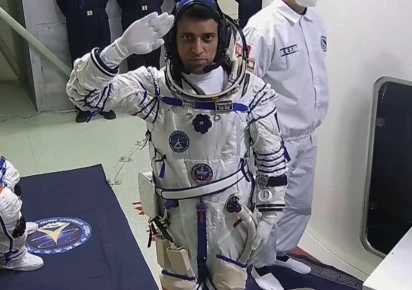
Pakistan reached a historic milestone in space exploration on Wednesday as astronaut Muhammad Zeeshan Ali embarked on the Shenzhou-24 mission to China’s Tiangong space station, marking a significant development in scientific and technological cooperation between Islamabad and Beijing.
The Shenzhou-24 spacecraft, mounted on a Long March-2F carrier rocket, lifted off from the Jiuquan Satellite Launch Centre in northwestern China at 8:18am Beijing time, according to the China Manned Space Agency (CMSA).
Approximately 10 minutes after liftoff, the spacecraft successfully separated from its launch vehicle and entered its designated orbit.
The CMSA declared the launch “a complete success,” confirming that the spacecraft had completed the initial stage of its journey as planned.
The mission carries a three-member crew comprising Chinese astronauts Tang Hongbo, who serves as mission commander and spacecraft pilot, flight engineer Wu Yi, and Pakistan’s Muhammad Zeeshan Ali.
The spacecraft will next undertake a rapid automated rendezvous and docking procedure with the Tiangong orbital complex, after which the astronauts are expected to enter the space station.
Chinese space authorities confirmed that Tiangong had entered the appropriate docking orbit and that conditions aboard the station were suitable for the spacecraft’s arrival and the crew’s transfer.
The mission represents an important step in Pakistan’s participation in international human spaceflight, opening new opportunities for collaboration in scientific research and advanced space technologies.
According to CMSA spokesperson Zhang Jingbo, more than 90 scientific experiments and technological tests have been planned for the Shenzhou-24 mission.
The research programme will cover several specialised fields, including space life sciences, materials science, microgravity fluid physics, combustion science, fundamental physics and space medicine.
Experiments involving emerging space technologies will also form part of the mission’s scientific objectives.
Ali’s participation is particularly significant for Pakistan, providing the country with representation in a crewed orbital mission and an opportunity to contribute to scientific activities aboard China’s space station.
The successful launch marks the beginning of a new chapter in Pakistan-China space cooperation, with the mission expected to strengthen bilateral collaboration in space science, research and technological development.