





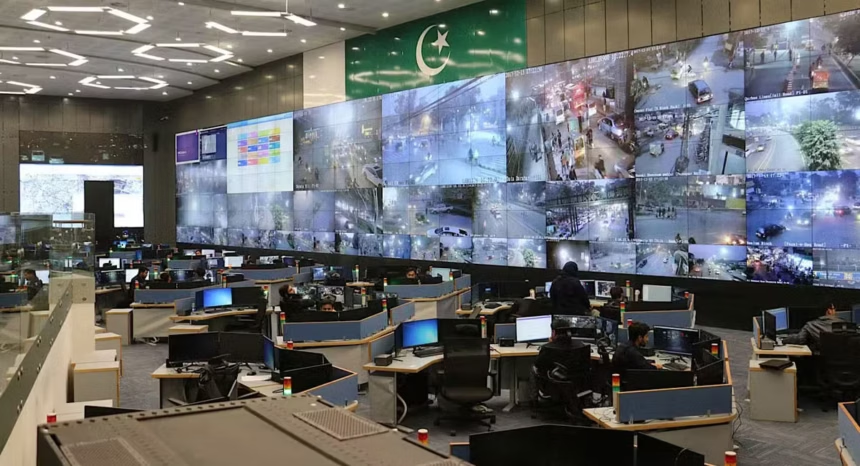
Sindh Chief Minister Syed Murad Ali Shah has directed the Sindh Safe Cities Authority (SSCA) to improve the operational efficiency of the Karachi Safe City Project, emphasising that investment in modern surveillance infrastructure must produce measurable improvements in public safety, crime prevention and law enforcement.
Chairing a meeting of the authority at the Chief Minister’s House on Tuesday, Shah reviewed the project’s progress, financial requirements, institutional capacity and operational performance during the first ten months of 2026.
He stressed that the project should go beyond installing surveillance equipment and ensure that technological resources contribute meaningfully to safer streets, more effective policing and better protection for citizens.
The chief minister instructed the authority to maintain uninterrupted operations of surveillance cameras, communication networks, control rooms and associated facilities, with particular attention to professional maintenance and system reliability.
During the meeting, SSCA Director General Sarfraz Shaikh presented an overview of the project’s first phase, implemented by the National Radio and Telecommunication Corporation (NRTC).
He informed participants that Phase-I comprises 300 pole sites equipped with 1,300 surveillance cameras, supported by 18 Points of Presence (PoPs), a dedicated Data Centre and a Network Operations Centre.
After reviewing the project’s maintenance requirements, Shah approved a revised six-month operations and maintenance proposal worth Rs189.75 million.
The approved arrangement carries an overall annual financial ceiling of Rs213.03 million, including expenditure on spare parts and optical fibre services. The revised maintenance arrangement is scheduled to take effect on January 1, 2027.
The chief minister directed officials to ensure transparency, strict financial oversight and clearly defined performance standards in the agreement.
He further instructed that fixed operational costs must not increase, services should be verified monthly, and financial deductions should be imposed wherever contractors fail to meet the agreed performance requirements.
Officials also presented a report detailing the contribution of the surveillance network to law enforcement operations between January and October 2026.
According to the briefing, the system helped authorities trace and hand over 1,631 vehicles, identify and hand over 84 wanted individuals to law enforcement agencies, and provide digital evidence in 642 instances to investigating formations.
The authority received 751 evidence-search requests from 23 investigating formations during the period, successfully facilitating 642 of them.
The system also processed 408 vehicle-arming requests and 32 person-arming requests, allowing law enforcement agencies to monitor specified vehicles and individuals through surveillance alerts.
Officials reported that 52 vehicles were traced through vehicle-arming alerts, while 14 government vehicles were handed over to police stations.
The chief minister highlighted the importance of linking these technological capabilities with effective police operations, underscoring the need to demonstrate results through improved investigations and public protection.
The meeting was attended by Sindh Home Minister Ziaul Hassan Lanjar, Chief Secretary Asif Hyder Shah, Home Secretary Iqbal Memon, Inspector General of Police Javed Odho, Principal Secretary to the Chief Minister Agha Wasif, Planning and Development Chairman Najam Shah, Local Government Secretary Waseem Shamshad, Excise Secretary Ali Ahmad Baloch, Finance Secretary Asghar Memon, SSCA Director General Sarfraz Shaikh and PDMA Director General Salman Shah.
Members of the Sindh Assembly Syed Sarfaraz Shah, Ali Hassan Hingorjo and Sumeta Afzal were also among the participants.
The review underscored the provincial government’s focus on strengthening technology-driven policing in Karachi while ensuring that public funds allocated to surveillance infrastructure are supported by financial accountability, operational reliability and demonstrable law enforcement outcomes.