





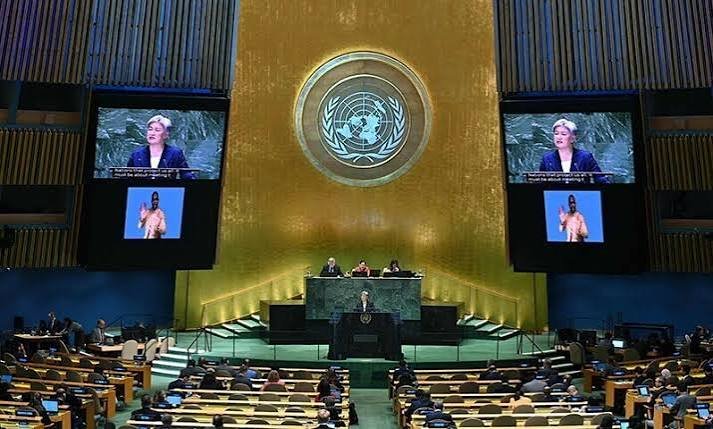
The United Nations was founded on the core principles of peace and security, sustainable development, and human rights for all. While these principles remain unchanged, their implementation has evolved significantly.
According to the UN Charter, the US, UK, France, Russia and China have veto power, meaning they can prevent any Security Council resolution from coming into force, even if all the other members agree. This demonstrates that the UN’s mission exists only on paper.
For decades, this practice was considered a necessary evil in order to encourage the world’s great powers to join the UN’s mission. However, the cracks are more noticeable than before.
Whenever diplomacy is most required at the Security Council, it fails, and the US administration is gravitating towards unilateral action, including recent military actions against Iran. This aims to achieve its own peace measures with little reference to the UN Charter, disregarding core principles such as respect for the territorial integrity of sovereign states.
It is worth considering that the very countries entrusted with protecting the system are making it optional. The question of whether the UN can still solve global problems is no longer theoretical.
Ukraine: Vetoes Into Irrelevance
One of the clearest tests of the UN’s ability to solve problems is Russia’s invasion of Ukraine. As a permanent member of the UN, Russia can veto any resolution condemning its actions, which it has done in the case of the Russia — Ukraine war.
The invasion has been discussed over forty times in the Security Council, yet no binding resolution demanding Russian withdrawal has ever been achieved because the invader sits at the meeting with the power to block it.
The human toll over the past four years is astounding. The Office of the United Nations High Commissioner for Human Rights (OHCHR) has declared 62,716 civilian casualties since the beginning of the invasion.
These attacks have included those on schools, hospitals and energy infrastructure. While the Security Council has been successful in condemning all the attacks and briefing the media about them, nothing beyond that would actually count as stopping the war. Vetoes work exactly as they are designed to.
Gaza: A Council Frozen by Its Own Members
On the one hand, we see what happens when the aggressor holds the veto, as in the case of Russia and Ukraine. On the other hand, we see what happens when the aggressor allies with a veto-holding power, as in Gaza.
Since the military campaign and operations in Gaza began, the United States has vetoed resolutions demanding a ceasefire, six times in total, thereby isolating Washington against all those in favour each time. More broadly, the US has blocked a total of 45 resolutions pertaining to the Israeli — Palestinian conflict since 1972, 19 of which concern the question of Palestine.
Each veto makes it harder to look away from the fact that tens of thousands of Palestinians have died and there is severe food insecurity in Gaza. Meanwhile, independent human rights investigators have declared that catastrophic violations are occurring in Gaza.
Yet none of these statistics has ever resulted in the Council passing a binding resolution endorsed by the US. Even if the General Assembly were to vote overwhelmingly in the other direction, this would carry moral weight, but not legal enforcement.
By allowing them to continue through its veto powers, the Security Council has repeatedly failed to stop the military actions, occupation and humanitarian crises in Palestine, particularly in Gaza — one of the most devastating conflicts in the world today.
Climate: Big Promises, Small Breakthroughs
Although the UN’s climate process has achieved notable successes, such as the Paris Agreement and the Loss and Damage Fund, there is a significant discrepancy between these achievements and the situation on the ground.
For example, UN member countries agreed to raise 1.3 trillion dollars a year for developing countries by 2035. Yet the UN Conference on Trade and Development has verified that 900 billion dollars is needed immediately.
The UN has been entrusted with preventing global conflict, yet has struggled to enforce its mandates. Since the 2015 Paris Agreement, emissions have risen by 10 per cent, and forecasters are now warning that the world could exceed the 1.5°C threshold within five years.
This issue was discussed at COP30 in Belém. However, concerningly, 88 countries voted to drop the plan to phase out fossil fuels after objections from oil-producing countries.
Pandemics and Hunger
After three years of negotiations, the WHO adopted a Pandemic Agreement. This agreement set no binding rules for any country, ultimately allowing a country to sign it and ignore it. The US subsequently withdrew its funding and participation from the framework, weakening the initiative before it could begin to work effectively.
Millions of people, especially in Sudan and Gaza, now face acute hunger as the World Food Programme’s budget fell by 40 per cent to 6.4 billion dollars.
A year ago, humanitarian aid reached over 2.2 million people in Somalia, but this figure has now dropped to 350,000. This is not because the need has gone away, but because there are no wealthy countries willing to fund it.
Reform on Paper and Reinvention
The UN is well aware of all this. Secretary-General António Guterres has repeatedly described Security Council reform as “long overdue”, and proposals have been made to address the above failures, such as introducing permanent seats for Africa, Latin America and Asia, and restricting and regulating the use of the veto.
However, in a decentralised world where countries such as the US, China, and Russia pursue their own spheres of influence without adhering to a rules-based order, no permanent member is incentivised to relinquish the power to protect its own interests.
This can be seen in the geopolitical conflicts involving Russia’s actions in Ukraine, the US’s diplomatic positioning regarding Gaza, and the refusal of various major powers to acknowledge sanctions aimed at restoring regional sovereignty.
Each of the above angles tells the same story collectively. The UN has repeatedly failed to turn its mandate, forum and even language into binding action to solve global problems.
The death of over 62,716 civilians in the Russia — Ukraine war, the ongoing crises in Gaza, unsatisfactory climate funding, the loss of major financial backers for pandemic treaties, and Somalia losing aid for millions overnight are all examples of real crises unfolding globally that the UN is responsible for preventing.
The UN is not just in need of reinvention or reformed commitments from its most powerful members; it needs to restrict the P5 from treating the veto as the first move rather than the last resort. Until this is achieved, the UN will be no more than a body that briefs, releases statements and condemns the crises it was built to prevent.